Drain
Garden Drainage Solutions Across North West England
Standing water, waterlogged lawns and persistently wet planting areas can make a garden difficult to use and damage lawns, plants, paving and structures.
Effective drainage begins with understanding why the water is collecting. A French drain, soakaway or channel drain will only work if it addresses the actual cause and has somewhere appropriate for the water to go.
Landscaping Emporium provides garden-drainage assessment and installation across North West England, either as an individual improvement or as part of a wider landscaping project.
Signs that your garden may have a drainage problem
Common symptoms include:
Standing water after rainfall
A lawn that remains wet or muddy
Water collecting beside the house
Puddles forming on paving
Water flowing towards doors or thresholds
Plants failing in persistently wet soil
Moss and algae developing rapidly
Soil with an unpleasant stagnant smell
Water collecting at the bottom of slopes
Saturated areas around retaining walls
Paths becoming muddy or unstable
Water appearing after neighbouring construction work
A garden that cannot be used for long periods during winter
Some temporary surface water after exceptionally heavy rainfall is normal. A problem is more likely where water remains for extended periods, appears after ordinary rainfall or repeatedly collects against buildings and structures.
Why is my garden waterlogged?
Garden drainage problems can have several causes. More than one may be present at the same property.
Heavy clay soil
Clay particles are very fine and hold water for longer than sandy or loamy soils. Once clay becomes saturated, additional water may remain on the surface.
Clay is common across many parts of North West England. It does not automatically mean that the garden needs extensive drainage, but soil structure and water movement need to be understood.
Compacted ground
Soil can become compacted by:
Construction machinery
Repeated foot traffic
Vehicles
Material storage
Previous building work
Poor ground preparation
Working the soil when it is too wet
Compaction reduces the spaces through which water and air would normally move.
New-build construction
New-build gardens frequently contain compacted subsoil, rubble and a relatively shallow layer of imported topsoil.
Water may collect where:
The underlying ground has been heavily compacted.
Construction debris restricts drainage.
Garden levels have been poorly formed.
Topsoil has been spread over an impermeable layer.
Water flows from neighbouring plots.
The development’s drainage does not manage garden run-off effectively.
Incorrect garden levels
Water naturally travels towards lower areas.
If the garden slopes towards the house, patio or retaining wall, water can collect in vulnerable positions.
Levels should direct water safely away from buildings without transferring the problem onto neighbouring land.
Paving without sufficient falls
Patios and paths require a suitable fall to move surface water towards an appropriate drainage point.
Problems can occur where:
Paving has been installed too level.
The fall runs towards the house.
The surface contains low spots.
Drainage channels are blocked.
Water has no suitable outlet.
Surrounding ground is higher than the paving.
Roof and building drainage
Leaking or overflowing gutters, damaged downpipes and unsuitable discharge points can release a substantial volume of water into the garden.
Before installing new garden drainage, check that rainwater from buildings is being managed correctly.
Water moving from neighbouring land
Water may enter from adjoining gardens, fields or higher ground.
A drainage solution must account for the direction, volume and frequency of this incoming water. Simply adding soil or raising one area may redirect the problem elsewhere.
A naturally high water table
Some sites remain wet because groundwater is close to the surface.
A conventional soakaway may not work where the surrounding ground is already saturated or where groundwater remains high for long periods.
More detailed investigation may be required before a suitable solution can be designed.
Start with a drainage assessment
There is no single solution for every wet garden.
Before recommending work, consider:
Where the water originates
When it appears
How long it remains
Soil type
Ground levels
Existing drains
Nearby buildings
The location of utilities
Access
Neighbouring land
The proposed use of the garden
Whether water has a lawful and practical destination
Photographs taken during or shortly after heavy rainfall can be extremely helpful. A dry-weather site visit may not reveal the full extent of the problem.
Lawn drainage
A lawn may remain wet because of compaction, heavy soil, poor levels or inadequate preparation beneath the surface.
Possible improvements include:
Hollow-tine aeration
Scarification where appropriate
Topdressing
Relieving localised compaction
Improving the soil structure
Regrading low areas
Installing land drains
Reconstructing the lawn profile
Replacing unsuitable soil
Improving water movement at the edges
Surface treatments will not correct every problem. Where compaction or unsuitable ground extends well below the lawn, more substantial work may be necessary.
New turf should not be laid over unresolved waterlogging, as the underlying problem will normally reappear.
French drains
A French drain normally consists of a perforated drainage pipe surrounded by clean, free-draining aggregate and separated from the soil with an appropriate geotextile.
It can collect water and direct it towards a suitable outlet.
French drains may be useful:
Along the bottom of a slope
Beside a waterlogged lawn
Behind retaining structures, when properly designed
Around the edge of a patio
To intercept water moving across the garden
Within a broader land-drainage system
A French drain is not simply a trench filled with gravel. Its depth, fall, pipe, aggregate, membrane and destination all affect whether it will work.
Without a suitable outlet, the trench may become another place for water to collect.
Land drains
Perforated land-drainage pipes can be installed within trenches to collect and move water through the garden.
The layout may use:
A single collector drain
Parallel drainage runs
A herringbone arrangement
Interceptor drains
Connections to an approved discharge point
The appropriate spacing and depth depend on the soil, levels, water source and intended use of the area.
Existing utilities must be identified before excavation.
Soakaways
A soakaway stores surface water temporarily and allows it to infiltrate gradually into the surrounding ground.
A soakaway is only suitable where:
The soil has adequate infiltration
Groundwater conditions allow it
There is sufficient space
Required distances from buildings and boundaries can be achieved
The proposed location is appropriate
The expected volume of water can be managed
Relevant permissions and regulations are satisfied
A soakaway will not work properly in every clay garden. If the surrounding soil cannot absorb the water, the soakaway may remain full.
An infiltration test and suitable professional design may be required.
Patio and paving drainage
Patios should be installed with appropriate falls so that water moves away from buildings and does not remain on the paving.
A patio-drainage design may include:
Falls formed within the paving
Linear drainage channels
Threshold drains
Slot drains
Gullies
Permeable areas
Connections to an approved drainage system
Gravel margins where appropriate
Retaining and edge details
Drainage channels need regular cleaning. Leaves, soil and jointing debris can prevent water reaching the outlet.
Explore our paving collection, or use our patio cost calculator to plan a professionally installed porcelain patio.
Threshold drainage
Where paving is installed close to a doorway, garden room or other building threshold, a suitable drainage channel may be required.
Threshold drainage helps intercept water before it reaches the building.
The detail must consider:
Finished paving level
Damp-proof-course level
Door design
Required falls
Channel capacity
Outlet position
Accessibility for cleaning
Installing a channel without a suitable outlet will not solve the underlying drainage problem.
Retaining walls and raised gardens
Water can build up behind retaining walls and create additional pressure.
Appropriate drainage may include:
Free-draining backfill
Drainage pipes
Weep holes
Waterproofing or tanking where specified
Geotextile separation
A suitable discharge point
Retaining structures must be designed for the site conditions and expected loads. Significant walls may require professional structural design.
Planting in damp or wet ground
Not every wet area needs to be made completely dry.
Where the water conditions are understood and do not threaten buildings or structures, moisture-tolerant planting can form part of the solution.
Possible approaches include:
Rain-garden planting
Moisture-tolerant trees and shrubs
Bog planting
Swales
Seasonal wet areas
Planting designed to slow surface water
Improving soil structure with appropriate organic matter
Plants alone will not correct severe compaction, uncontrolled run-off or water collecting against a building.
For suitable boundary planting, read our guide to hedging for damp and wet soil.
Drainage for trees and hedging
New trees and hedging need moisture, but their roots also need oxygen.
Planting into waterlogged ground can lead to:
Poor root development
Yellowing foliage
Dieback
Root decay
Plant failure
Increased susceptibility to stress and disease
A planting hole should not be treated as an isolated sump within impermeable clay. Improving only the hole can sometimes encourage water to collect around the roots.
The wider soil conditions and movement of water must be considered.
Use our Find My Hedge selector or specimen tree selector to compare plants against the site conditions.
Improving clay soil
Clay soil can often be improved through a combination of:
Reducing compaction
Adding appropriate organic matter
Protecting the soil from repeated trafficking
Avoiding cultivation when saturated
Mulching
Using suitable plants
Improving surface levels
Installing drainage where genuinely required
Adding a small amount of sand to heavy clay does not automatically improve drainage and can create an unhelpful soil structure.
Any soil-improvement plan should be appropriate for the scale and condition of the site.
Sustainable drainage
A good drainage design should manage water responsibly rather than moving it away as quickly as possible without considering the destination.
Depending on the site, sustainable measures might include:
Permeable surfaces
Rain gardens
Swales
Water butts
Attenuation
Soakaways where suitable
Planting that slows surface run-off
Reducing unnecessary hard paving
Directing water into appropriate planted areas
The objective is to control water close to where it falls without creating problems for buildings, neighbours or the wider drainage network.
Can garden water be connected to a sewer?
Surface-water connections are controlled and may require approval. A garden drain should not be connected to a foul sewer or existing system without confirming that the connection is lawful, suitable and capable of receiving the water.
The correct approach depends on:
The property’s drainage arrangement
Local requirements
Sewer ownership
Available capacity
Site levels
The type and source of the water
Appropriate drainage advice and permissions should be obtained before making any connection.
Will a gravel trench solve the problem?
Not necessarily.
A gravel trench may allow water to move more freely locally, but it does not make the water disappear.
Before installing one, establish:
Where the water will enter
Where it will leave
Whether the trench has a suitable fall
Whether the surrounding soil can absorb water
Whether a perforated pipe is required
Whether sediment will enter the aggregate
How the drain will be maintained
A gravel-filled trench without a functioning destination may simply become saturated.
Why has the problem appeared after landscaping?
Drainage can change when:
Garden levels are altered
Soil is compacted
New paving is installed
Borders are raised
Retaining walls are constructed
Lawns are regraded
Buildings or garden rooms are added
Neighbouring work changes water movement
Existing drainage becomes blocked
Drainage should therefore be considered as part of the initial garden design rather than after construction is complete.
Our garden-drainage process
Initial discussion
We ask when and where the water appears, how long it remains and whether the problem has changed over time.
Photographs taken during wet conditions are useful.
Site assessment
We inspect levels, soil, existing drainage, buildings, hard landscaping and potential sources of water.
Recommendations
We explain the likely causes and recommend proportionate work. This may involve ground improvement, regrading, drainage installation or changes to the proposed garden layout.
Installation
Where agreed, the drainage work is installed alongside the appropriate excavation, aggregate, pipework, outlets and reinstatement.
Review
The completed work is checked, although its full performance may only become clear during subsequent periods of heavy rainfall.
Garden drainage across North West England
Landscaping Emporium provides garden-drainage and landscaping services across North West England.
We work throughout Lancashire, Greater Manchester, Cheshire, Merseyside and surrounding areas, including Blackburn, Bolton, Chorley, Clitheroe, Formby, Knutsford, Lytham, Manchester, Preston, Ribble Valley, Southport, Warrington, Whalley and Wigan.
Drainage work can form part of:
Patio installation
Lawn construction
Garden redesign
Planting preparation
Retaining work
New-build garden improvement
Complete landscaping projects
Learn more about our bespoke landscaping service.
Request a garden-drainage assessment
If your garden remains waterlogged, photographs taken during wet weather are a useful starting point.
Contact Landscaping Emporium with details of:
Where the water collects
How long it remains
When the problem began
Recent construction or landscaping
Existing drains
The approximate area affected
Photographs during and after rainfall
We can then discuss whether a site assessment is appropriate and what further investigation may be required.
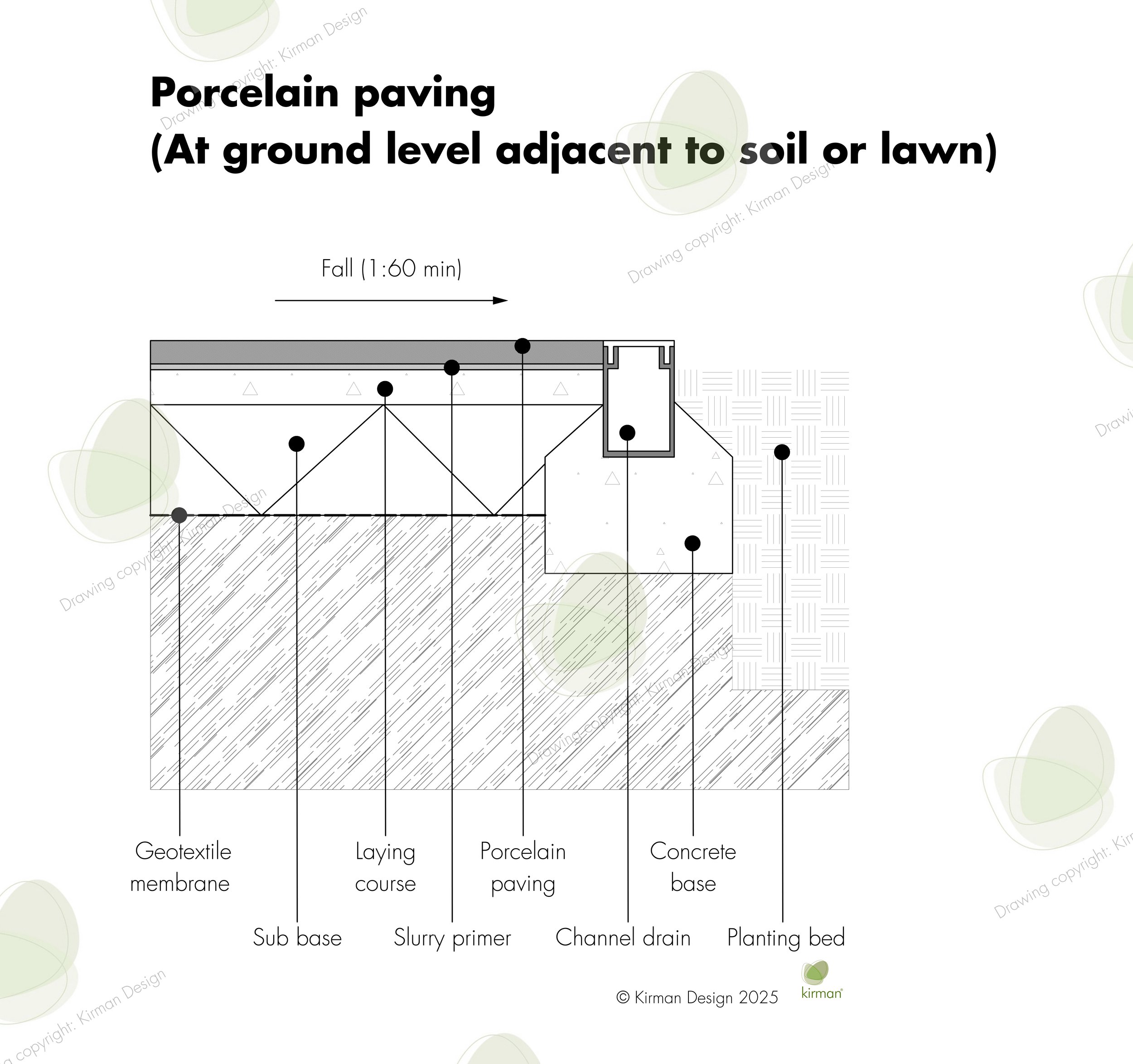
Porcelain paving
(At ground level, adjacent to soil or lawn)

Porcelain paving
(At ground level, with drainage adjacent to the house)
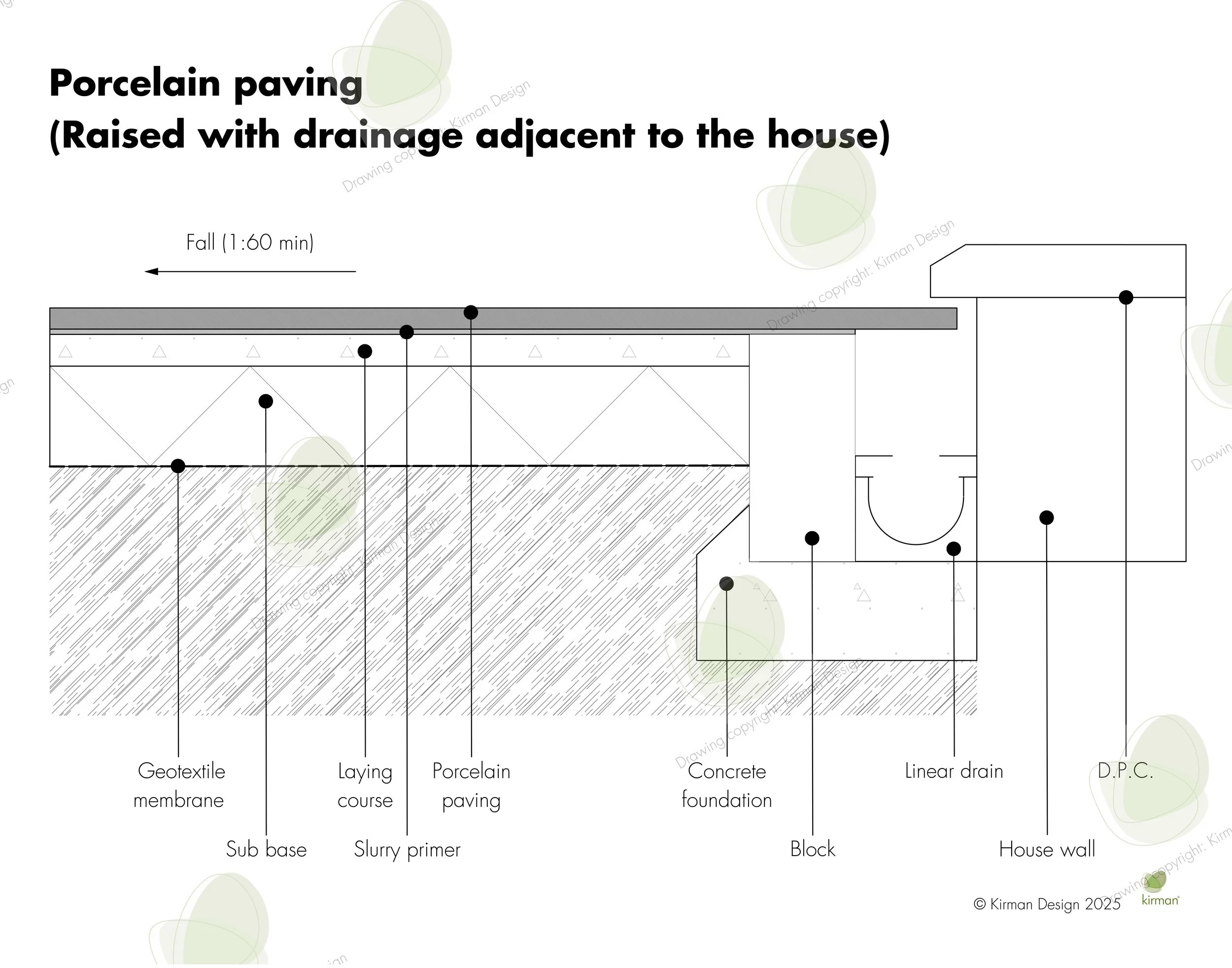
Porcelain paving
(Raised, with drainage adjacent to the house)
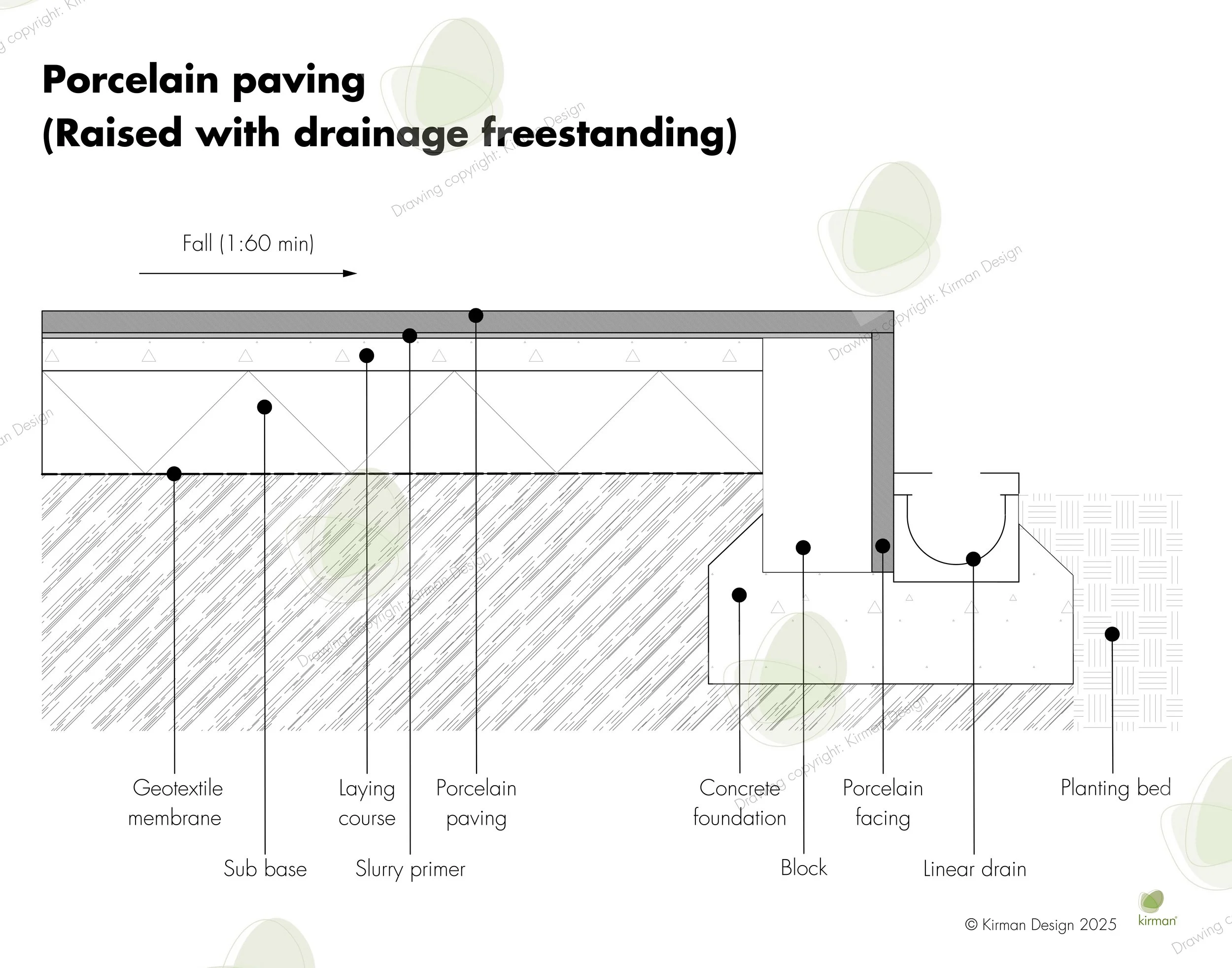
Porcelain paving
(Raised, with drainage, freestanding)