Hedge
Create privacy, structure, shelter and a greener garden boundary with hedging selected for your particular space.
Landscaping Emporium supplies bare-root and rootballed hedging plants in a wide range of species and sizes. Our collection includes evergreen screening plants, traditional deciduous hedges, native species, flowering plants and hedging for more challenging conditions.
Professional planting is available across North West England, with irrigation, mulch and protective stock fencing available where required.
Browse the collection below or contact our team for help choosing the right hedge.
Hedging Plants Supplied and Professionally Planted
Choosing the Right Hedge
The best hedge is not necessarily the fastest-growing or most evergreen option. It needs to suit the soil, light, available space, required height and level of maintenance you can provide.
Before choosing a species, consider:
Why the hedge is needed.
The required height and width.
Whether year-round screening is essential.
The amount of sunlight available.
Soil type and drainage.
Exposure to wind.
Proximity to buildings and boundaries.
How quickly the hedge needs to establish.
The amount of regular maintenance required.
Whether wildlife value is important.
Whether children, pets or grazing animals use the area.
Our collection filters can help you narrow the available products by purpose, growing conditions and plant characteristics.
Hedging for Privacy and Screening
A hedge can create privacy while retaining a softer and more natural appearance than a solid fence.
Evergreen species provide consistent foliage throughout the year, while deciduous and marcescent hedges can offer seasonal interest, filtered light and a less visually heavy boundary.
The appropriate choice depends on where the privacy is needed, the required screening height and the amount of space available for the mature hedge.
For a detailed comparison of suitable species, read our guide to screening hedging.
Evergreen Hedging
Evergreen hedging retains foliage throughout the year and is often chosen where dependable screening is the principal requirement.
Popular evergreen options include:
Taxus baccata: a refined, long-lived native evergreen suitable for formal and informal hedges.
Prunus lusitanica ‘Angustifolia’: Portuguese Laurel with smaller leaves and an elegant appearance.
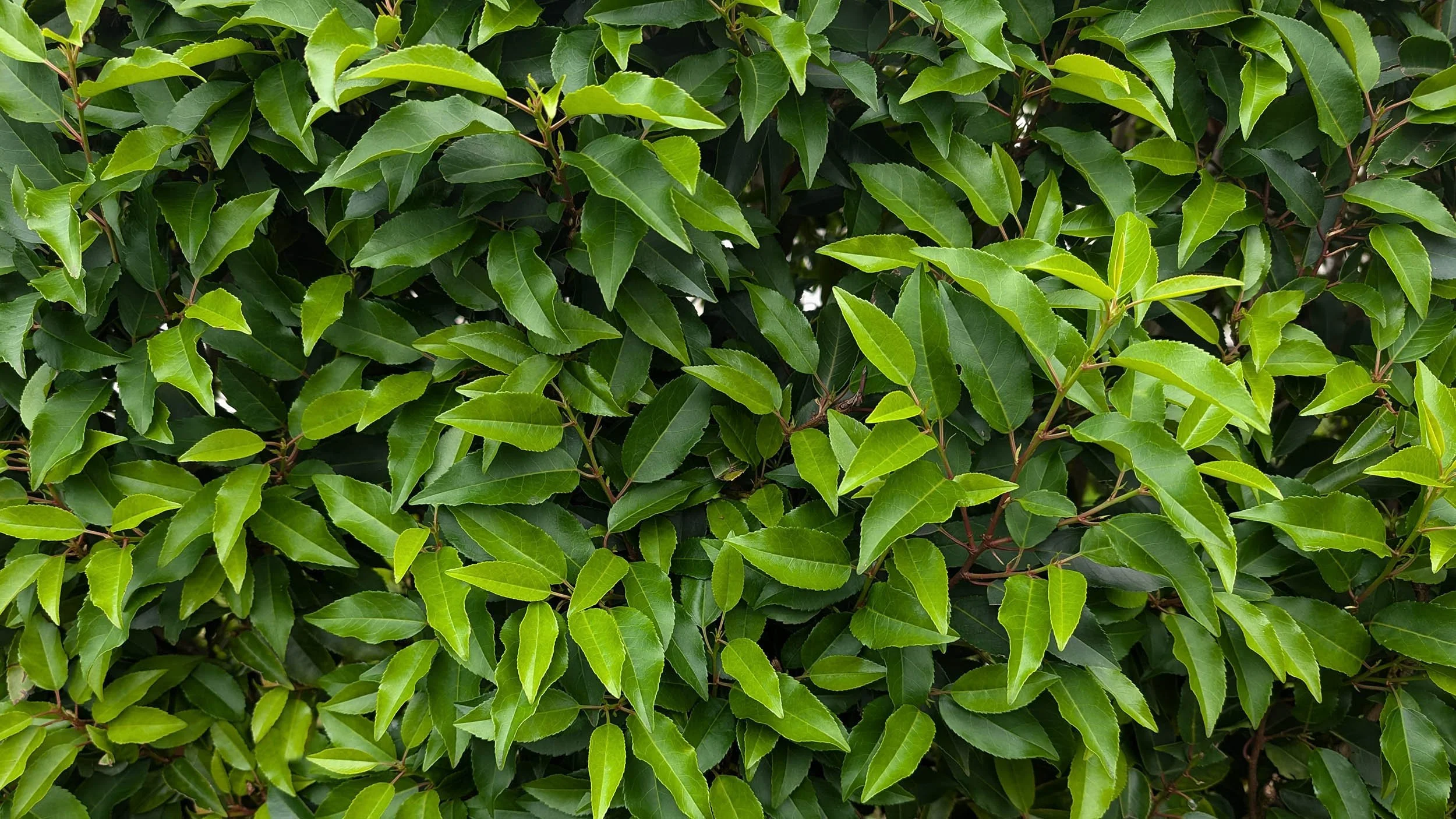
Prunus laurocerasus ‘Rotundifolia’: vigorous Cherry Laurel with large, glossy foliage.
Photinia × fraseri ‘Red Robin’: evergreen screening with colourful red young growth.
Thuja plicata ‘Atrovirens’: a dense conifer suitable for substantial evergreen boundaries.
Cuprocyparis leylandii: a very fast-growing conifer that requires regular maintenance.
Evergreen plants still differ considerably in growing speed, mature size, appearance and maintenance.
Compare evergreen hedging plants.
Deciduous and Marcescent Hedging
Deciduous hedges lose their leaves during autumn and winter, but this does not mean that they are unsuitable for screening.
Beech and Hornbeam are marcescent hedges. They can retain a proportion of their dried leaves through winter, particularly when clipped regularly, providing more seasonal screening than fully deciduous species.
Popular choices include:
Carpinus betulus: Hornbeam, particularly useful for heavier and damper ground.
Fagus sylvatica: Green Beech for well-drained soils.
Fagus sylvatica ‘Atropunicea’: Purple Beech with dark seasonal foliage.
Acer campestre: Field Maple, a native species with attractive autumn colour.
Crataegus monogyna: Hawthorn, a robust native hedge with flowers and berries.
Corylus avellana: Hazel, useful within informal and mixed native hedges.
Deciduous hedging allows changing light through the seasons and can provide valuable habitat for wildlife.
Native Hedging
Native hedging supports insects, birds and other wildlife while creating a boundary suited to the wider landscape.
A single native species can form an attractive garden hedge, or several compatible plants can be combined to create a more informal mixed hedge.
Common native hedging plants include:
Field Maple.
Hawthorn.
Hazel.
Hornbeam.
Blackthorn.
Dogwood.
Rowan.
Elder.
Spindle.
Guelder Rose.
Beech.
Yew.
Native hedges are particularly suitable for rural properties, wildlife gardens, agricultural boundaries and gardens adjoining the open landscape.
Explore native hedging options.
Flowering Hedging
Flowering hedges bring additional seasonal interest to a boundary.
Depending on the species, flowers may also provide nectar for pollinating insects, while later fruits or berries can support garden birds.
Flowering choices within our range may include:
Hawthorn.
Guelder Rose.
Cherry Laurel.
Portuguese Laurel.
Dogwood.
Elder.
Forsythia.
Rowan.
Bird Cherry.
Photinia.
Some flowering hedges are best allowed to grow more informally. Very frequent clipping can remove flower buds and reduce the display.
Discover flowering hedging plants.
Fast-Growing Hedging
Fast-growing hedging can create a boundary relatively quickly, but greater growth usually means more frequent pruning.
Leyland Cypress, Western Red Cedar, Laurel, Privet and some native plants can all establish rapidly in appropriate conditions.
The fastest-growing species is not always the best long-term choice. Available width, ultimate height, maintenance and the relationship with neighbouring properties should all be considered.
Hedging for Shade
Some hedging plants tolerate reduced light better than others.
Yew, Holly, Hornbeam, Beech, Portuguese Laurel and several native species may be suitable for partial shade, depending on soil and exposure.
Full shade beneath established trees presents additional challenges because the plants may also experience dry soil and competition from existing roots.
Read our guide to choosing the best hedge for shade.
Hedging for Clay Soil
Clay soil can be fertile but may remain wet during winter and become hard or cracked during dry weather.
Hornbeam, Hawthorn, Field Maple, Dogwood, Guelder Rose and several other robust species can perform well in clay when the ground is prepared properly.
Drainage, soil compaction and seasonal waterlogging must still be considered before planting.
Explore hedging for clay soil.
Hedging for Damp or Wet Ground
Persistently damp soil limits the range of suitable hedging, but several species tolerate moisture better than conventional Beech or drought-preferring evergreens.
Hornbeam, Alder, Dogwood, Guelder Rose and some Willows may be suitable, depending on the severity and duration of the wet conditions.
No hedge will thrive indefinitely in stagnant, completely waterlogged ground without oxygen around its roots. Drainage or changes to the planting method may be required.
Compare hedging for damp and wet soil.
Bare-Root Hedging
Bare-root hedging is lifted from nursery fields while the plants are dormant and supplied without soil around the roots.
It is generally available between late autumn and early spring, depending on weather and species.
Bare-root plants are often the most cost-effective choice for:
Long hedge lengths.
Native mixed hedges.
Rural boundaries.
Larger planting schemes.
Customers willing to allow a younger hedge time to establish.
Bare-root plants must be handled carefully and planted promptly. The roots must not be allowed to dry out.
Availability is seasonal and orders should be planned before the dormant planting period wherever possible.
Rootballed Hedging
Rootballed hedging is field-grown and lifted with a ball of soil retained around the roots. The rootball is normally secured using hessian and wire.
Rootballed plants are usually available in larger sizes than standard bare-root material and can create a more immediate effect.
Rootballed hedging is well suited to:
Gardens requiring faster visual impact.
Taller privacy hedges.
More established evergreen planting.
Formal garden boundaries.
Projects requiring larger individual plants.
Rootballed plants are heavy and may require specialist delivery, handling and professional planting.
The hessian and appropriate untreated wire are normally left in place during planting unless the nursery or plant specification states otherwise.
Which Stock Type Should I Choose?
Choose bare-root plants when cost efficiency, longer hedge lengths and seasonal planting are the main considerations.
Choose rootballed plants when you require larger plants, more immediate impact or species commonly supplied in established sizes.
The final choice should also consider:
Time of year.
Species.
Required plant height.
Access.
Handling.
Available budget.
Irrigation.
How quickly screening is needed.
Contact us if you are uncertain which stock type is most appropriate.
SHOP HEDGING PLANTS
Place the Hedge product-summary block here.
Use “Shop Hedging Plants” as the collection heading. Do not repeat “Hedge” as another H1 or H2.
Allow customers to filter the collection by characteristics such as:
Bare root or rootballed.
Evergreen or deciduous.
Native status.
Growing speed.
Sun or shade.
Soil conditions.
Privacy and screening.
Flowering or fruiting.
Wildlife value.
Winter interest.
Agricultural use.
Thorns or other physical characteristics.
How Many Hedging Plants Do I Need?
The number of plants required depends on:
Species.
Plant size.
Stock type.
The desired speed of establishment.
Whether plants are arranged in a single or staggered double row.
The supplier’s recommended spacing.
The total hedge length.
Planting too widely can leave gaps for several years. Planting excessively closely increases cost and can create unnecessary competition between plants.
Use our guide to calculate how many plants you need for your hedge, or contact us with the hedge length and preferred plant size.
Professional Hedge Planting
Professional planting is available across our working area in North West England.
Depending on the site and quotation, hedge installation can include:
Setting out the hedge line.
Ground preparation.
Excavation of a trench or individual planting pits.
Soil improvement where appropriate.
Positioning and planting.
Initial watering.
Supports where required.
Irrigation.
Mulching.
Protective stock fencing.
Removal of reasonable planting waste.
The exact work required depends on the plant size, hedge length, soil, access and existing site conditions.
Hedging Irrigation
Newly planted hedging requires consistent watering while its root system establishes.
An irrigation system can make it easier to deliver water evenly along the complete hedge, particularly where plants are large or the hedge is long.
Irrigation does not remove the need to inspect the plants and soil. The frequency and duration of watering must be adjusted for rainfall, temperature, soil type, plant size and season.
Hedging irrigation is available as an additional product within the collection.
Bark Mulch for Hedging
A suitable bark mulch can help to:
Reduce competition from weeds.
Conserve soil moisture.
Moderate changes in soil temperature.
Protect the soil surface.
Give the newly planted hedge a finished appearance.
Mulch should be applied over prepared, moist soil and kept away from direct contact with plant stems and trunks.
Bark mulching is available as an addition to qualifying hedge orders and planting projects.
Stock Fencing
Stock fencing may be needed where new hedging could be damaged by livestock or larger animals.
The fencing should protect the plants without preventing healthy hedge development or future maintenance.
Its height, specification and position depend on the animals, site and type of hedge.
Stock fencing can be quoted alongside eligible hedge planting projects.
Delivery, Access and Planting Conditions
Hedging orders can be large, heavy and difficult to move.
Before delivery, tell us about:
Narrow roads.
Restricted parking.
Narrow gates or entrances.
Steps and level changes.
Long distances from the unloading point.
Soft or unstable ground.
Overhead cables or branches.
Vehicle height or weight restrictions.
Limited turning space.
Restricted delivery hours.
Photographs, measurements and an accurate postcode help us plan the appropriate delivery method.
Read our detailed information about hedge delivery, access and planting.
Looking After a Newly Planted Hedge
New hedging requires active aftercare.
The most important tasks are:
Watering thoroughly after planting.
Monitoring soil moisture regularly.
Keeping the hedge line free from weeds and grass.
Maintaining mulch.
Checking ties, supports and irrigation.
Protecting plants from animals.
Replacing displaced soil after severe weather.
Pruning at the appropriate time for the species.
Hedge failure is often caused by insufficient or inconsistent watering during the establishment period.
The person responsible for ongoing watering should be agreed before planting takes place.
Hedging Supplied and Planted Across North West England
Landscaping Emporium supplies hedging plants with the option of professional planting across Lancashire, Greater Manchester, Cheshire, Merseyside, Cumbria and surrounding areas.
Our team can help you choose plants based on privacy, appearance, growing conditions, maintenance and the character of the surrounding garden.
Need Help Choosing a Hedge?
Read our hedging frequently asked questions or send us:
The planting postcode.
The proposed hedge length.
The required height.
Photographs of the area.
Details of sun and shade.
Any known soil or drainage problems.
Whether supply only or planting is required.
Call 01942 604976, email hello@landscapingemporium.co.uk or contact Landscaping Emporium.