Yew vs Laurel Hedging
Yew vs Laurel Hedging – Which Hedge Is Best?
Yew and Laurel are two of the best-known evergreen hedging choices, but they create very different types of hedge.
Both can provide year-round privacy, structure and screening. Both can be clipped into dense boundaries. And both can be supplied as larger plants where more immediate screening is required.
The similarities largely end there.
Yew (Taxus baccata) has fine, dark green foliage, relatively controlled growth and an exceptional ability to create precise formal hedges.
Laurel generally grows faster and has broader foliage, making it particularly effective where the priority is creating a substantial evergreen screen relatively quickly.
There is also an important distinction between Cherry Laurel and Portuguese Laurel. Cherry Laurel is vigorous and large-leaved, while Portuguese Laurel has smaller foliage and a more refined character.
So which should you choose?
The short answer is:
Choose Yew if you want a refined, long-lived, highly controllable evergreen hedge.
Choose Cherry Laurel if rapid, dense evergreen screening is the priority.
Choose Portuguese Laurel if you want something between the two — faster-growing than Yew but generally more refined than Cherry Laurel.
The full answer depends on your garden, soil, available space, required privacy and the appearance you want to create.
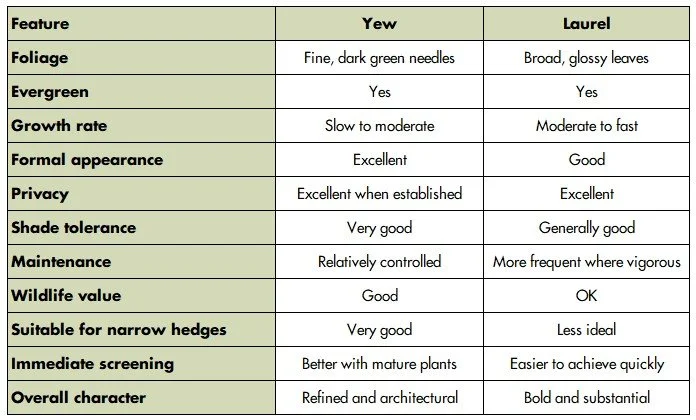
Yew vs Laurel at a Glance
Yew is generally the stronger option for formal gardens, narrow hedges, shade, long-term structure and controlled growth.
Cherry Laurel is generally stronger for rapid screening, broad evergreen coverage and creating substantial privacy from relatively young plants.
Portuguese Laurel occupies an attractive middle ground. It provides evergreen broadleaf screening and generally establishes faster than Yew, while its smaller leaves and darker appearance can create a more elegant hedge than Cherry Laurel.
None is universally better.
The objective is to match the hedge to the site and the job it needs to perform.
What Is Yew Hedging?
Yew, or Taxus baccata, is a native evergreen tree that has been used for formal hedging for centuries.
Its small dark green needles create an exceptionally dense surface when regularly clipped.
Unlike many coniferous hedging plants, established Yew also has an unusual ability to regenerate from older wood. This makes it much more forgiving if an established hedge eventually needs substantial renovation.
Yew grows relatively steadily rather than exceptionally quickly.
That can seem like a disadvantage when the hedge is young, but once it reaches the required size it becomes a significant benefit.
A hedge that naturally produces less excessive growth is easier to keep within carefully controlled dimensions.
Yew is particularly effective where the hedge itself is intended to become an important architectural part of the garden.
What Is Laurel Hedging?
“Laurel hedging” can describe several plants, but in British gardens it most commonly refers to Cherry Laurel (Prunus laurocerasus) and Portuguese Laurel (Prunus lusitanica).
Both are broad-leaved evergreens capable of producing dense privacy hedges.
Cherry Laurel has large, glossy green leaves and vigorous growth. It creates a bold, substantial screen and is frequently chosen where privacy needs to be established relatively quickly.
Portuguese Laurel has smaller, darker leaves and attractive reddish young stems. It generally creates a more refined hedge than Cherry Laurel and responds very well to regular clipping.
When comparing “Yew vs Laurel”, it is therefore worth deciding which Laurel you are actually considering.
Yew vs Cherry Laurel
Yew and Cherry Laurel represent the two ends of the comparison particularly clearly.
Cherry Laurel provides speed, large foliage and substantial screening.
Yew provides refinement, control, fine texture and longevity.
If you have a large boundary and want it green and screened as quickly as reasonably possible, Cherry Laurel may be the better choice.
If you have a designed garden where the hedge needs to remain precise, elegant and relatively narrow for many years, Yew may justify its slower establishment.
Yew vs Portuguese Laurel
This is a much closer comparison.
Both can create high-quality evergreen hedges suitable for formal residential gardens.
Portuguese Laurel generally establishes faster and has attractive glossy leaves and reddish young growth.
Yew has much finer foliage, a darker appearance and a particularly strong architectural character.
For an extremely precise clipped hedge, Yew has the advantage.
Where you want an elegant broad-leaved evergreen hedge with somewhat faster growth, Portuguese Laurel can be an excellent alternative.
Which Grows Faster – Yew or Laurel?
Laurel generally grows faster than Yew.
This is one of the principal reasons Laurel is so popular for privacy screening.
Cherry Laurel can produce vigorous annual growth in favourable conditions and can develop into a substantial hedge relatively quickly.
Portuguese Laurel also provides useful growth, although its character is generally more restrained than Cherry Laurel.
Yew grows more steadily.
However, growth rate should not be considered only during the establishment period.
A fast-growing hedge reaches the required size sooner, but it continues growing after it gets there.
That means the same vigour that initially makes Laurel attractive can eventually result in more pruning.
Yew takes longer to develop from small plants, but once it reaches the required dimensions its controlled growth can become a major long-term advantage.
If speed is your overriding concern, see our Fast Growing Hedging guide.
Which Is Better for Privacy?
Both Yew and Laurel can create excellent privacy.
Laurel generally achieves dense screening more quickly when starting with relatively small plants because of its faster growth and larger foliage.
Yew takes longer to develop from young stock but can eventually create an exceptionally dense evergreen screen.
The important distinction is whether you need privacy eventually or immediately.
If you are prepared to wait, either can produce an excellent hedge.
If you need privacy now, the answer may not be choosing Laurel instead of Yew. It may be buying larger mature plants.
Mature Yew and mature Laurel can both provide substantial screening immediately.
If this is your priority, explore our Instant Hedges options.
Which Is Better for Screening Neighbours?
For conventional boundary-level screening, both work extremely well.
Cherry Laurel can create a broad, dense barrier relatively quickly.
Yew creates a more controlled and refined long-term screen.
The more important question is often where the unwanted view comes from.
If neighbours can see directly through the boundary at ground level, a conventional hedge may solve the problem.
If the garden is overlooked from first-floor or second-floor windows, simply allowing a hedge to become increasingly tall may not be the best solution.
In that situation, foliage is required at a higher level.
A combination of evergreen hedging with specimen trees or pleached trees can provide more effective screening while avoiding an unnecessarily enormous hedge.
For alternatives, see our Trees for Screening Neighbours and Pleached Trees & Pleached Hedging guides.
Which Is Better for a Formal Garden?
Yew is generally the stronger choice.
Its fine foliage responds exceptionally well to clipping and can create very clean, precise surfaces.
This makes it particularly suitable for formal boundaries, garden rooms, entrances and gardens with strong architectural geometry.
Yew can look equally appropriate beside a traditional country property or a highly contemporary house.
Portuguese Laurel can also create an excellent formal hedge where a broader-leaved evergreen appearance is preferred.
Cherry Laurel can be clipped formally, but the large leaves create a much bolder texture.
Which Is Better for a Contemporary Garden?
Both Yew and Portuguese Laurel can work extremely well in contemporary gardens.
Yew provides a dark, restrained backdrop that works particularly well with pale paving, architectural planting, ornamental grasses and strong geometric layouts.
Portuguese Laurel creates a slightly softer effect while retaining enough structure for contemporary design.
Cherry Laurel tends to be more appropriate where the primary objective is screening rather than creating a finely detailed architectural hedge.
Which Is Better for a Traditional Garden?
Yew has an obvious association with traditional British gardens, historic properties and formal landscapes.
Its dark foliage and ability to create precise hedges give it a timeless quality.
Laurel can also work well in traditional settings, particularly where a softer or more substantial evergreen backdrop is required.
Portuguese Laurel is particularly useful where you want broad-leaved evergreen foliage without the visual weight of Cherry Laurel.
Which Is Better for a Small Garden?
Yew is often the better choice where garden width is limited.
It responds exceptionally well to regular clipping and can be maintained as a relatively narrow hedge.
This is important in small gardens because every centimetre of usable space matters.
Cherry Laurel naturally wants to develop into a broader plant and can consume significant garden space if maintenance is neglected.
Portuguese Laurel is generally easier to control than Cherry Laurel but will still produce broader foliage than Yew.
For a narrow boundary beside a path, driveway or small patio, Yew is therefore particularly useful.
Which Is Better for a Large Garden?
All three can work successfully in larger landscapes.
Yew can create long formal lines, divide large gardens into separate rooms and provide an architectural framework around more informal planting.
Cherry Laurel can rapidly create substantial green screening around large boundaries.
Portuguese Laurel can provide a sophisticated evergreen backdrop without appearing quite as heavy as Cherry Laurel.
In larger gardens, available width becomes less restrictive, so the decision can focus more heavily on style, speed and long-term maintenance.
Which Tolerates Shade Better?
Yew is particularly good in shade.
It can remain dense in conditions where many other hedge species become thin or struggle to establish.
Cherry Laurel also tolerates partial shade well, and Portuguese Laurel can perform successfully where light levels are reasonable.
The complication is that shade is not always simply a lack of sunlight.
Shade beneath mature trees can also involve severe root competition and dry soil. Shade beside buildings may create a rain shadow.
A hedge that is botanically shade tolerant can still struggle if it cannot obtain enough water.
For a detailed comparison of suitable species, see Hedging for Partial Shade.
Which Is Better for Full Sun?
Both Yew and Laurel can perform well in full sun where the soil and establishment conditions are suitable.
Laurel may produce particularly strong growth in favourable sunny positions.
Yew remains an excellent choice where a more controlled hedge is preferred.
For either species, newly planted hedging needs reliable watering while its root system becomes established.
This becomes increasingly important with larger mature plants.
Which Is Better for Clay Soil?
Both Yew and Laurel can grow in clay soil provided the ground has adequate structure and drainage.
The crucial distinction is between clay soil and waterlogged clay soil.
Yew particularly dislikes prolonged waterlogging.
Laurel can also struggle where roots remain saturated for long periods.
If your soil is extremely heavy, compacted or regularly waterlogged, improving the ground or selecting a different hedge species may be preferable to forcing either plant into unsuitable conditions.
For alternatives, see Hedging for Clay Soil.
Which Is Better for Dry Conditions?
Established Yew can be remarkably resilient once its root system has developed.
Laurel can also tolerate periods of dry weather once established, but its larger leaves can lose substantial amounts of moisture.
Neither should be treated as drought-proof immediately after planting.
Newly planted evergreen hedging needs consistent establishment watering, particularly during spring and summer.
The larger the plants, the greater the importance of getting this right.
Which Requires More Maintenance?
Laurel will generally require more frequent control because it grows faster.
Cherry Laurel in particular can quickly exceed its intended dimensions if regular pruning is neglected.
Yew grows more steadily and is therefore easier to maintain within a precise long-term size.
Portuguese Laurel sits somewhere between the two.
Maintenance should therefore be considered as part of the original purchase decision.
If you want the fastest hedge possible, remember that the growth does not stop when the hedge reaches two metres.
Is Yew Easier to Keep Narrow?
Yes.
This is one of Yew's greatest advantages.
Its fine foliage and excellent response to clipping allow it to be maintained as a relatively narrow hedge.
This makes it particularly valuable beside driveways, paths, patios and within smaller gardens.
Laurel naturally develops broader growth.
It can certainly be clipped, but keeping a vigorous Cherry Laurel hedge very narrow generally requires more maintenance.
Which Can Be Cut Back Harder?
Yew has an important advantage over many evergreen conifers because it is capable of producing new growth from old wood.
This means an established Yew hedge can often be renovated successfully even after substantial pruning.
Laurel is also capable of responding strongly to hard pruning.
Both are therefore relatively forgiving hedging plants compared with some evergreens that cannot recover once they are cut back beyond the green foliage.
That does not mean severe pruning should be carried out without consideration of timing, plant health and the condition of the hedge.
Which Looks Better After Clipping?
This is subjective, but Yew generally produces the finer formal finish.
Its small needles create a smooth, dense surface.
Cherry Laurel has much larger leaves. Mechanical hedge trimmers can cut through individual leaves, leaving visible damaged edges immediately after trimming.
For the best appearance, Laurel may therefore benefit from more careful pruning.
Portuguese Laurel's smaller foliage generally produces a neater clipped appearance than Cherry Laurel.
Which Is Better for a Driveway?
Yew is particularly effective beside driveways because it can be maintained tightly without unnecessarily reducing vehicle space.
It also creates a strong formal approach to a property.
Portuguese Laurel is another excellent option where a slightly softer broad-leaved evergreen hedge is preferred.
Cherry Laurel can work where sufficient width is available, particularly if substantial screening is needed.
Whatever species you choose, allow for the finished hedge width, not simply the width of the plants when they are installed.
Which Is Better for a Front Garden?
For smaller front gardens, Yew is often the strongest choice because it can remain neat and relatively narrow.
Portuguese Laurel can also work beautifully where a slightly softer evergreen hedge is desired.
Cherry Laurel may become disproportionately large in some front gardens unless it is kept under regular control.
The required finished height should also take account of entrance visibility, driveways and the relationship between the garden and street.
Which Is Better for a Boundary Hedge?
Both can make excellent boundary hedges.
For rapid broad screening, Laurel generally has the advantage.
For controlled long-term structure, Yew is difficult to beat.
Portuguese Laurel is particularly useful where you want a compromise between those two characteristics.
Before deciding, consider the desired appearance, required speed, available width, maintenance, soil, shade and budget.
Which Is Better for Roadside Screening?
Cherry Laurel's dense broad foliage can create an effective visual screen relatively quickly.
Yew can also create an excellent roadside boundary where a more formal long-term treatment is preferred.
Site conditions matter considerably in these situations.
Exposure, drainage, soil conditions and any road-salt exposure should all be considered before selecting the hedge.
Which Is Better for Wildlife?
Both provide wildlife value.
Yew's dense evergreen growth provides valuable year-round shelter. Female Yew plants can produce red arils containing seeds.
Laurel provides dense evergreen cover and flowers that can be visited by insects.
However, if biodiversity is your principal objective, a mixed native hedge may provide a greater diversity of habitat and food sources than either single-species evergreen hedge.
See Hedging Which Is Native to the UK for alternatives.
Is Yew Poisonous?
Yes.
Most parts of Taxus baccata contain toxic compounds and should not be eaten.
This is particularly important where livestock or animals likely to browse the hedge have access to the planting.
The red fleshy aril is the exception, but the seed inside it is toxic and should not be consumed.
Yew's toxicity should therefore form part of the decision where the hedge will be accessible to grazing animals or other situations where ingestion is a realistic risk.
Is Laurel Poisonous?
Laurel should also not be eaten.
Cherry Laurel foliage and seeds contain cyanogenic compounds that can be harmful if ingested.
As with Yew, this should be considered where livestock or animals likely to browse hedging have direct access.
Plant toxicity is particularly relevant when selecting hedging for paddocks and agricultural boundaries.
How Tall Can Yew Hedging Grow?
Yew is naturally capable of becoming a substantial tree.
As a hedge, however, it can be maintained at many different heights.
It can form a relatively low formal boundary or a substantial privacy screen.
Its excellent response to clipping means the finished dimensions can be controlled over the long term.
The appropriate height should be determined by what the hedge needs to achieve and its relationship with neighbouring properties and the wider garden.
How Tall Can Laurel Hedging Grow?
Both Cherry Laurel and Portuguese Laurel can become substantial plants if left untrimmed.
As hedges, they are normally controlled through regular pruning.
Because Laurel can grow relatively vigorously, it is better to establish the desired finished height and width early rather than allowing the plants to become much larger and then repeatedly carrying out heavy renovation pruning.
What Size Yew or Laurel Plants Should I Buy?
This depends primarily on how quickly you need the hedge to provide useful screening.
Smaller plants cost less, are easier to transport and can establish extremely successfully, but they need time to develop.
Larger plants cost more but allow you to effectively buy several years of growth.
Where privacy is urgent, that additional investment can make sense.
Where you have time for the hedge to develop naturally, smaller plants may provide better value.
Our Hedging Plant Sizes Explained guide compares the common sizes from young hedging through to mature specimens.
Rootballed Yew and Laurel
Larger Yew and Laurel plants may be supplied as rootballed stock during the appropriate planting season.
These plants are grown in nursery fields before being lifted with soil retained around their root systems.
Rootball production allows substantial mature plants to be moved and provides access to sizes considerably larger than ordinary young hedging.
The disadvantage is weight.
A substantial rootball can be extremely heavy, making site access, transport and handling important considerations.
Professional planting may therefore be appropriate for larger specimens.
Container-Grown Yew and Laurel
Yew and Laurel can also be supplied as container-grown plants.
Container-grown stock provides greater flexibility over planting time because the root system is already established within the growing medium.
This does not mean the plants can simply be planted at any time and forgotten.
Large evergreen plants installed during warm weather can have considerable water requirements.
Where summer planting is unavoidable, a proper watering or irrigation plan becomes particularly important.
Mature Yew vs Mature Laurel
Once you compare mature plants rather than young hedging, Laurel's faster growth becomes less important.
A substantial mature Yew hedge can provide significant privacy immediately.
At that point, the decision should focus much more heavily on appearance, available width, long-term maintenance, soil conditions and garden style.
Yew tends to produce the more restrained architectural result.
Cherry Laurel creates the broader, bolder green screen.
Portuguese Laurel offers an attractive compromise between the two.
Which Is Cheaper – Yew or Laurel?
Laurel will generally be less expensive than Yew when comparing plants intended to provide a similar level of initial screening.
One reason is Yew's slower nursery production.
It takes time to produce substantial dense Yew plants, and that production time is reflected in the cost.
However, purchase price is only one part of the comparison.
A faster-growing hedge may require more maintenance over its lifetime.
A Yew hedge may cost more initially but be easier to maintain within precise dimensions.
The correct comparison is therefore purchase cost + installation + establishment + long-term maintenance + the quality of the result you actually want.
Which Is Better for a High-End Garden?
For a highly designed garden, Yew is often exceptional.
Its fine texture, dark foliage and clipping ability allow it to become part of the garden's architecture rather than simply a boundary.
Portuguese Laurel can be equally successful where a slightly softer broad-leaved evergreen effect is wanted.
Cherry Laurel tends to be selected more heavily for its practical screening qualities.
That does not make Cherry Laurel inferior. It simply creates a different visual result.
The right hedge should complement the architecture, planting style and overall level of refinement within the garden.
Yew vs Laurel – Which Should You Choose?
If your priority is a refined formal hedge, choose Yew.
If your priority is rapid evergreen screening, consider Cherry Laurel.
If you want faster establishment than Yew but a more refined appearance than Cherry Laurel, Portuguese Laurel is an excellent option.
If your garden is narrow, Yew has a significant advantage because it can be maintained tightly.
If your garden is shady, Yew is particularly strong, although Laurel can also tolerate partial shade.
If you have heavy or wet soil, assess drainage carefully before choosing either.
If you need privacy immediately, compare mature plants and Instant Hedging rather than selecting solely according to the growth rate of young plants.
And if wildlife is the principal objective, consider whether a Native Hedge might be more appropriate.
Frequently Asked Questions About Yew vs Laurel
Is Yew better than Laurel?
Neither is universally better. Yew is generally better for precise formal hedging, narrow spaces, shade and controlled long-term growth. Laurel is generally better where faster evergreen screening is the priority.
Which grows faster, Yew or Laurel?
Laurel generally grows faster. Cherry Laurel in particular can develop relatively quickly in favourable conditions.
Which provides better privacy?
Both can provide excellent privacy. Laurel generally develops screening faster from small plants, while mature Yew can create equally substantial privacy.
Which is easier to maintain?
Yew's slower, more controlled growth can make it easier to maintain at a fixed size. Laurel generally requires more frequent pruning because it grows faster.
Which is better for a small garden?
Yew is often preferable because it can be maintained as a relatively narrow hedge.
Which is better for shade?
Yew is exceptionally shade tolerant. Laurel can also perform well in partial shade.
Which is better for clay soil?
Both can tolerate clay where drainage is adequate. Yew is particularly unsuitable for prolonged waterlogging, so very wet clay needs careful consideration.
Which is better, Yew or Portuguese Laurel?
Yew creates a finer, more formal and controlled hedge. Portuguese Laurel generally grows faster and provides a softer broad-leaved evergreen appearance.
Which is better, Yew or Cherry Laurel?
Choose Yew for refinement and long-term control. Choose Cherry Laurel where rapid, substantial evergreen screening is more important.
Is Yew more expensive than Laurel?
It commonly is when comparing plants of a similar size because Yew grows more slowly and takes longer to produce at the nursery.
Can I buy mature Yew hedging?
Yes. Larger Yew can provide substantial immediate screening and removes much of the disadvantage of waiting for smaller Yew plants to grow.
Can Yew and Laurel be planted together?
They can, but mixing them randomly within the same formal hedge will usually create differences in foliage, growth rate and maintenance. In most designed gardens, we would normally choose one species for the principal hedge and use other plants elsewhere in the scheme.
Can Yew or Laurel screen upstairs windows?
Potentially, but simply growing a conventional hedge extremely tall may not be the best solution. Pleached or specimen trees can provide foliage at the height where screening is actually required.
Can Landscaping Emporium supply and plant Yew or Laurel?
Yes. Yew, Portuguese Laurel and Cherry Laurel can be supplied, with professional planting available for suitable projects across North West England.
Yew & Laurel Hedging Supplied and Planted
The best hedge is not simply the fastest-growing or cheapest plant.
It is the hedge that suits the site, available space, required privacy and character of the garden.
Landscaping Emporium can supply Yew, Cherry Laurel and Portuguese Laurel hedging, with professional planting available for suitable projects across Lancashire, the Ribble Valley, Greater Manchester, Cheshire, Merseyside and surrounding parts of North West England.
For a complete installation service, see Hedging Supplied & Planted.
If you need an established screen immediately, explore Instant Hedges.
If you are unsure what size plants to purchase, read Hedging Plant Sizes Explained.
For a shady boundary, see Hedging for Partial Shade.
And where soil conditions are difficult, read Hedging for Clay Soil before deciding.
Still Not Sure Whether to Choose Yew or Laurel?
Send Landscaping Emporium your postcode, approximate hedge length, required height and photographs of the planting area.
It is also useful to tell us whether the hedge needs to provide immediate privacy, how much sunlight the boundary receives and whether the soil tends to remain wet.
We can then help you compare Yew, Cherry Laurel and Portuguese Laurel based on the actual conditions rather than simply recommending whichever species grows fastest.
For a high-quality formal hedge with exceptional longevity and control, Yew is difficult to beat.
For faster, substantial evergreen screening, Laurel has a clear advantage.
And where you want a combination of evergreen screening, relatively good growth and a more refined broadleaf
Yew vs Laurel at a Glance