Stone paving
FAQ
Frequently asked questions.
Paving FAQs – Porcelain & Stone Paving
Choosing paving is one of the most important decisions when creating a new patio or landscaped garden.
The material needs to look right alongside the house and garden, but appearance is only part of the decision. Slip resistance, maintenance, durability, installation, drainage, colour, jointing and the way the paving responds to the British climate all matter too.
At Landscaping Emporium, we supply paving and offer professional patio installation across North West England. This guide answers some of the questions we are most frequently asked about porcelain and stone paving.
If you are ready to explore the available options, visit our Paving & Patios collection.
Porcelain Paving FAQs
What is porcelain paving?
Porcelain paving is a manufactured outdoor paving material produced from refined clay and other natural materials that are fired at extremely high temperatures.
The manufacturing process creates a dense, hard material with very low water absorption.
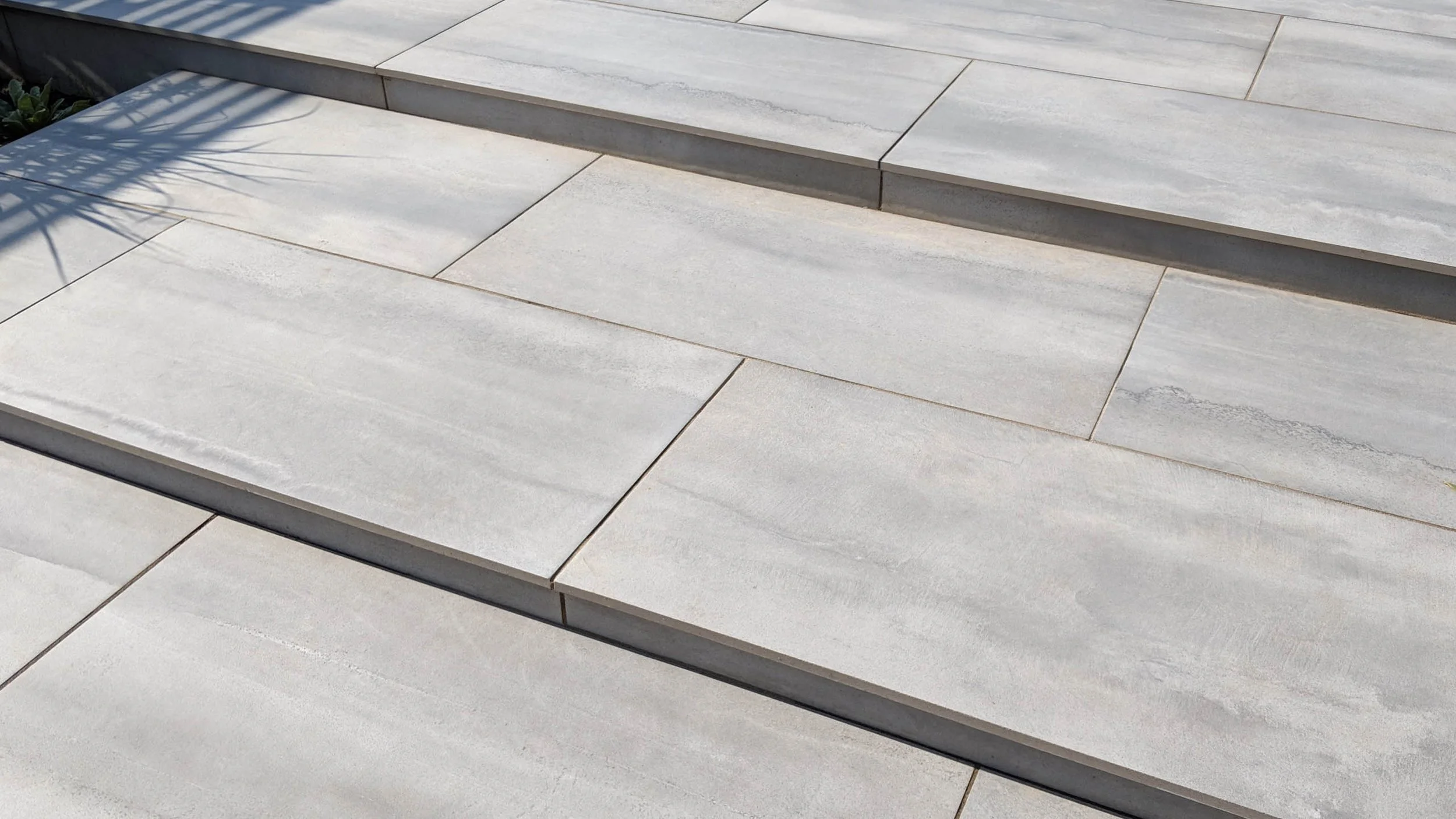
Modern outdoor porcelain is available in a huge variety of colours, textures and finishes, including products designed to recreate the appearance of natural stone, concrete and other materials.
This combination of appearance, consistency and performance is why porcelain has become such a popular choice for contemporary garden design.
What are the benefits of porcelain paving?
One of porcelain's greatest advantages is that it combines a refined appearance with relatively straightforward maintenance.
Its low porosity means that it absorbs very little moisture compared with many natural stones. This makes it resistant to staining and helps it perform well in gardens exposed to the wet conditions we frequently experience across North West England.
Porcelain also provides considerable design flexibility. Different colours and surface finishes can work with contemporary houses, traditional properties and everything in between.
When properly specified and installed, it can create a durable patio that should continue looking good for many years.
What are the disadvantages of porcelain paving?
No paving material is perfect for every garden.
Porcelain does not naturally weather and develop patina in the same way as natural stone. For someone wanting a very traditional, rustic or aged appearance, genuine stone may therefore be more appropriate.
Porcelain also requires correct installation. Cutting the material requires appropriate equipment and the paving needs to be installed using a construction method suitable for external porcelain.
Poor installation can undermine the advantages of even a very good paving product.
That is why the quality of the installation should be considered alongside the quality of the paving itself.
Is porcelain paving better than natural stone?
Neither material is universally better.
Porcelain is particularly attractive where you want colour consistency, low water absorption, relatively low maintenance and a clean contemporary finish.
Natural stone provides genuine geological variation. Each piece is naturally different, and the paving can develop character as it ages.
The right choice therefore depends on the property, garden style and the appearance you want to create.
A contemporary extension with large areas of glazing may suit porcelain beautifully, while an older rural property might benefit from the natural variation of stone.
Does porcelain paving look artificial?
Good-quality porcelain can recreate natural stone remarkably effectively, but it remains a manufactured product.
That is actually one of its advantages.
Manufacturing provides greater control over dimensions, colour ranges and surface characteristics than is possible with a completely natural material.
Individual slabs can contain subtle variations in pattern and tone so that a finished patio does not appear excessively repetitive.
When choosing a product, it is worth looking at several slabs together rather than judging the entire range from a single sample.
Does porcelain paving vary in colour?
Yes, although generally less than natural stone.
Porcelain is manufactured to create a controlled appearance, but variations can occur between production batches.
This becomes particularly important if you intend to extend a patio several years later.
A newly manufactured batch may not perfectly match the original paving even if the product has the same name.
For that reason, we recommend keeping spare slabs from the original installation wherever practical.
Is every porcelain paving slab identical?
Not necessarily.
Many porcelain ranges deliberately incorporate subtle variations in pattern and tone to recreate the character of natural materials.
This helps prevent a patio looking excessively uniform.
During installation, the slabs should be considered as a complete composition so that repeated patterns or very similar slabs are not unnecessarily grouped together.
Does porcelain paving fade?
Quality external porcelain is highly resistant to colour fading.
The colour and surface are created through a controlled manufacturing process designed to withstand prolonged outdoor exposure.
This makes porcelain particularly useful where maintaining a consistent appearance is important.
As with any external surface, dirt, algae and atmospheric deposits can temporarily alter how the paving looks, but these can generally be removed through appropriate cleaning.
Porcelain Paving and Safety
Is porcelain paving slippery when wet?
Outdoor porcelain should be selected specifically for external use.
We recommend choosing paving with an appropriate slip-resistant surface rather than using porcelain designed for internal floors.
Many of the outdoor porcelain products selected by Landscaping Emporium have an R11 slip-resistance classification, making them suitable for external patio applications.
Surface texture remains important, particularly in gardens where the paving will regularly become wet.
The paving should therefore be selected according to its intended use rather than appearance alone.
What does R11 mean on porcelain paving?
R ratings are used to describe the slip resistance of flooring and paving under particular test conditions.
An R11-rated outdoor porcelain tile provides a relatively high degree of slip resistance and is commonly specified for external areas.
It does not mean that a surface can never become slippery.
Leaves, mud, algae, ice and other contamination can reduce grip on almost any paving surface.
Regular cleaning and sensible garden maintenance therefore remain important.
Can porcelain paving become slippery with algae?
Yes.
Although porcelain absorbs very little water, dirt and organic material can still accumulate on its surface.
In damp or shaded areas this can encourage algae to develop, which may make the paving slippery.
The advantage of porcelain is that the surface is generally straightforward to clean.
Keeping the patio clear of leaves and organic debris and periodically washing the paving can help maintain its appearance and slip resistance.
Porcelain Paving in the British Climate
Is porcelain paving suitable for North West England?
Yes.
Porcelain can be an excellent choice for gardens across Lancashire, Greater Manchester, Cheshire, Merseyside and the wider North West.
Our climate means paving regularly experiences rainfall, prolonged damp conditions and occasional freezing temperatures.
Porcelain's very low water absorption makes it particularly attractive in these conditions.
The paving still needs to be installed correctly, with suitable falls, drainage, bedding and jointing.
A high-quality slab cannot compensate for poor patio construction.
Is porcelain paving frost resistant?
Outdoor porcelain has very low water absorption, which makes it highly resistant to freeze-thaw damage.
This is one of its principal advantages in the British climate.
However, a patio is a complete construction rather than simply a collection of slabs.
The sub-base, bedding system, joints, drainage and installation quality all contribute to the long-term performance of the finished patio.
Does porcelain paving get hot in the sun?
Like most external surfaces, porcelain can warm up in prolonged direct sunlight.
Colour makes a difference.
Darker paving generally absorbs more solar energy than pale paving and can therefore become warmer.
For very sunny gardens where people may regularly walk barefoot, lighter-coloured porcelain may be worth considering.
In North West England this is usually less of an issue than it can be in much hotter climates, but it is still worth considering when selecting colour.
Porcelain Paving Durability
How long does porcelain paving last?
A well-manufactured external porcelain product that has been professionally installed should provide a very long service life.
Rather than concentrating on an arbitrary number of years, we recommend considering the complete patio construction.
Correct excavation, sub-base preparation, bedding, bonding, falls, drainage and jointing are all critical.
If the construction beneath the paving fails, even an extremely durable surface material can move or become damaged.
Good paving therefore starts below the slab.
Does porcelain paving scratch?
Porcelain is highly resistant to everyday scratching, which makes it well suited to patios containing garden furniture, tables, chairs and planters.
It is not indestructible, however.
Dragging very heavy or abrasive objects across any finished surface can potentially cause damage.
Lifting furniture rather than dragging it and using appropriate feet or pads beneath particularly heavy objects is sensible practice.
Can porcelain paving crack?
Yes, although correctly specified porcelain is extremely strong.
Cracking is more likely to be associated with impact, movement or problems within the construction beneath the paving than ordinary pedestrian use.
A properly constructed base is therefore essential.
This is particularly important in areas with poor ground conditions or where significant excavation and filling have been required.
Porcelain Paving Maintenance
Is porcelain paving low maintenance?
Yes. This is one of the main reasons people choose it.
Because porcelain absorbs very little moisture, staining and organic growth are generally easier to manage than with more porous materials.
Low maintenance does not mean no maintenance.
Leaves, soil, bird droppings, food, grease and general garden dirt still need to be removed.
Periodic cleaning will keep the patio looking considerably better and reduce the opportunity for algae to develop.
How do I clean porcelain paving?
For routine maintenance, sweeping and washing with clean water may be sufficient.
More stubborn dirt can usually be treated with a cleaning product specifically suitable for external porcelain.
Always check that a cleaning chemical is compatible with the paving and jointing material before applying it across the entire patio.
Testing a small inconspicuous area first is sensible.
Do I need to seal porcelain paving?
Porcelain paving generally does not require sealing in the same way that some porous natural stones may.
Its extremely low porosity is one of its principal advantages.
There may be specialist circumstances or products where manufacturers provide different guidance, so the instructions supplied with the particular paving should always be followed.
Can I pressure-wash porcelain paving?
Porcelain itself is extremely durable, but care should still be taken around the joints.
An excessively powerful pressure washer held very close to the paving may damage or dislodge some jointing materials.
Use appropriate pressure and follow the recommendations for both the paving and the jointing product.
Pots, Furniture and Porcelain Patios
Can I put plant pots on porcelain paving?
Yes.
Pots and planters can be positioned on porcelain patios without causing structural problems to the paving.
However, constantly trapping moisture and dirt beneath a large pot can leave marks or deposits on the surface.
Pot feet can improve airflow and drainage beneath containers and make periodic cleaning easier.
Can I put heavy garden furniture on porcelain?
Generally, yes.
External porcelain is designed to cope with normal patio furniture.
Care should be taken with very heavy items and with furniture that concentrates weight through narrow or sharp feet.
Protective pads can be useful, and furniture should be lifted rather than dragged wherever practical.
Can I install an outdoor kitchen on porcelain paving?
Yes, provided the patio has been designed and constructed for the loads involved.
An outdoor kitchen can be considerably heavier than ordinary garden furniture.
Ideally, its location should therefore be known before the patio is constructed so that the underlying construction can be designed appropriately.
This is one of the advantages of planning paving as part of the complete garden rather than treating it as an isolated surface.
Porcelain Patio Installation FAQs
How should porcelain paving be installed?
External porcelain should be installed on a properly prepared base using a method suitable for the product and site conditions.
The exact construction depends on the ground and project, but correct excavation, sub-base preparation, falls, bedding, bonding and jointing all matter.
We strongly recommend treating installation quality as part of the paving purchase decision.
Landscaping Emporium provides both paving products and professional installation across North West England. You can explore our Paving & Patio options for more information.
Does porcelain paving need a fall?
Yes.
Outdoor patios need to shed surface water appropriately.
Even though porcelain itself absorbs very little moisture, water still needs somewhere to go.
The finished paving should therefore be constructed with appropriate falls and drainage appropriate to the garden and surrounding buildings.
This is particularly important close to doors, extensions and other thresholds.
Can porcelain paving be laid completely flat?
The finished appearance can look level, but external paving generally requires a subtle fall to manage surface water.
The fall may be visually almost imperceptible when properly designed.
Trying to create a genuinely dead-flat external surface can encourage water to remain on the patio after rainfall.
How wide should porcelain paving joints be?
Joint width depends on the paving product, laying pattern and manufacturer's recommendations.
Consistent joints are important both visually and technically.
The jointing product also needs to be compatible with porcelain and suitable for external use.
How long after installation can I walk on a porcelain patio?
The required curing period depends on the installation system, weather and products used.
You should follow the installer's advice rather than relying on a universal number of hours.
Walking on paving or placing furniture onto it before bedding and jointing materials have adequately cured can compromise the finished installation.
Will there be mess while my patio is being installed?
Patio construction inevitably involves some disruption.
Existing surfaces may need to be removed, soil excavated and substantial quantities of aggregate, bedding materials and paving brought into the garden.
There may also be cutting, dust and waste removal.
A professional installation should manage this process carefully, but a garden under construction will inevitably look worse before it looks better.
Once the groundwork is complete and the finished paving begins to be installed, the transformation becomes much more apparent.
Patio Drainage FAQs
Why is drainage important when installing a patio?
Water needs to be managed rather than simply pushed towards another part of the property.
The design should consider the direction of falls, surrounding ground levels, existing drainage and the relationship between the patio and the house.
Poor drainage can create standing water, saturated borders or problems around buildings.
This is why drainage should be considered at the design stage rather than after the paving has already been installed.
Do I need a threshold drain outside my doors?
That depends on the relationship between the patio and the building.
Where paving meets doors at a low or level threshold, appropriate drainage detailing may be required to intercept water and protect the building.
This should be assessed as part of the patio design and installation rather than assuming the same detail is appropriate for every property.
Choosing Porcelain Paving
What porcelain paving colour should I choose?
Start with the house rather than the paving catalogue.
Consider the brick, render, stonework, window frames, doors and internal flooring visible through large areas of glazing.
The paving should feel as though it belongs to the architecture and wider garden.
Warm beige and stone tones can soften a contemporary landscape, while greys can work particularly well with modern architecture.
Very pale paving can make a space feel brighter, while darker surfaces can create stronger contrast.
There is no universally correct colour.
What paving size should I choose?
Larger-format slabs can create a clean contemporary appearance with fewer joints, while smaller formats can work particularly well where the layout contains curves, intricate detailing or smaller spaces.
The proportions of the patio also matter.
Rather than choosing a slab simply because it is fashionable, consider how the dimensions work with the overall area and laying pattern.
Should paving run towards or across the house?
The orientation of rectangular paving can influence how the proportions of a space are perceived.
Running slabs in one direction can visually lengthen the patio, while rotating them can emphasise width.
There is no single rule.
The best orientation responds to the architecture, principal viewing direction, garden geometry and paving dimensions.
Should I order spare paving slabs?
Yes, where possible.
Keeping a small quantity of spare paving from the original batch can be extremely useful if a slab is accidentally damaged in the future or alterations become necessary.
This is particularly important with porcelain because manufacturing batches can vary slightly in tone.
A spare slab from the original installation provides the best chance of an exact match.
Can I extend a porcelain patio later?
Yes, but matching the existing paving can become difficult.
Even if the same product remains available, a later production batch may have subtle colour or pattern differences.
Products can also be discontinued.
If you think an extension is likely in the near future, it is worth considering that when planning the original patio.
Porcelain Paving Costs
Is porcelain paving expensive?
Porcelain is available at a range of price points.
The paving itself is only one part of the total patio cost.
Excavation, waste removal, sub-base materials, drainage, bedding, cutting, jointing and labour all contribute to the finished price.
This is why comparing two projects solely by the price per square metre of the slab can be misleading.
A professionally installed patio is a construction project, not simply a paving purchase.
Why are some porcelain paving products more expensive?
Differences can relate to manufacturing quality, surface finish, design, dimensions, pattern variation, consistency and the technical characteristics of the product.
A cheaper tile is not automatically poor quality and an expensive tile is not automatically the best option for your particular garden.
We recommend considering appearance, technical suitability and installation requirements together.
Natural Stone Paving FAQs
What is natural stone paving?
Natural stone paving is cut from quarried stone rather than manufactured to imitate it.
Depending on the product, this may include sandstone, limestone, granite and other stones.
Because it is a natural material, variations in colour, texture, veining and surface character are part of its appeal.
No two natural stone patios will be exactly the same.
Does natural stone paving change colour?
Natural stone can change in appearance as it weathers.
Moisture, sunlight, atmospheric conditions and organic growth can all influence the way the stone looks over time.
For many people this developing patina is one of the attractions of natural stone.
If you want a more controlled and consistent appearance, porcelain may be the better choice.
Does natural stone need sealing?
It depends on the particular stone, location and desired finish.
Some natural stones can benefit from an appropriate sealer, particularly where resistance to staining is important.
However, sealers can also alter appearance and need to be compatible with the stone.
Always follow advice appropriate to the specific material rather than assuming every natural stone requires the same treatment.
Is natural stone slippery?
Any external paving can become slippery when contaminated with algae, leaves, mud or ice.
The natural texture and finish of the stone also influence slip resistance.
Regular maintenance is therefore important regardless of the paving material chosen.
Porcelain or Natural Stone – Which Should I Choose?
This is ultimately a design decision as much as a technical one.
Choose porcelain if you value consistency, low water absorption, straightforward maintenance and a controlled contemporary finish.
Consider natural stone if you particularly value natural variation, geological character and the way genuine stone develops with age.
The architecture of the house should also influence the choice.
Paving occupies a large visual area within most gardens. It should therefore complement the property rather than simply being selected as an attractive sample in isolation.
Is Porcelain Paving Just a Fashion?
No.
Styles and colours inevitably change, but porcelain has technical characteristics that extend well beyond appearance.
Its low water absorption, durability, dimensional consistency and range of surface finishes make it a practical external paving material.
The more important question is whether a particular colour or pattern will date.
Choosing paving that responds to the architecture of the property rather than following a short-lived trend is generally the safer approach.
Can Landscaping Emporium Supply and Install My Patio?
Yes.
Landscaping Emporium offers selected paving products alongside professional installation across North West England.
Our approach is not simply to sell a slab. The finished result depends on selecting the right paving, designing the space properly and constructing the patio correctly.
If you are considering a new patio, explore our Paving & Patios section to see the available options.
Paving and Patio Installation Across North West England
We provide paving and professional patio installation for suitable projects across North West England.
Our experience of garden design and landscaping means the patio can be considered as part of the complete garden rather than simply an isolated rectangle of paving.
That includes thinking about its proportions, relationship with the house, furniture, outdoor kitchens, planting, drainage, lighting and how people will actually move through and use the space.
This design-led approach is particularly important because a patio represents a significant investment and is likely to remain part of the garden for many years.
Still Have a Question About Paving?
Choosing paving should involve more than deciding between grey and beige.
Think about how the patio will be used, how much maintenance you want, the architecture of the house, drainage, furniture and the wider garden.
For many gardens, porcelain provides an excellent combination of appearance, durability and low maintenance, while natural stone remains a beautiful choice where genuine natural variation and character are priorities.
Explore our Paving & Patios collection for available paving and professionally installed patio options.
If you are unsure which material is appropriate, contact Landscaping Emporium with photographs of your property, approximate patio dimensions and an idea of how you intend to use the space.
We can then help you choose a paving material that works with the house, the garden and the way you actually want to live outdoors.