Professional Water
Feature Supply
and Installation in Wigan
Premium Garden Water Features
Supplied by Kirman Design
A well-designed water feature can completely change the atmosphere of a garden.
The sound and movement of water can create a sense of calm, provide a strong visual focal point and introduce another dimension to an outdoor space. From a simple bubbling feature beside a patio to a bespoke rill incorporated into a complete garden design, water can become one of the most memorable elements of the garden.
Landscaping Emporium supplies and installs garden water features in Wigan and surrounding areas, backed by the garden design and landscaping experience of Kirman Design.
We can help with everything from selecting a suitable self-contained feature through to the design and construction of bespoke contemporary water features integrated into paving, planting and the wider garden.
Whether you are looking for a subtle feature or something that becomes the centrepiece of the garden, the important thing is that the water feature feels as though it belongs in the space.
-
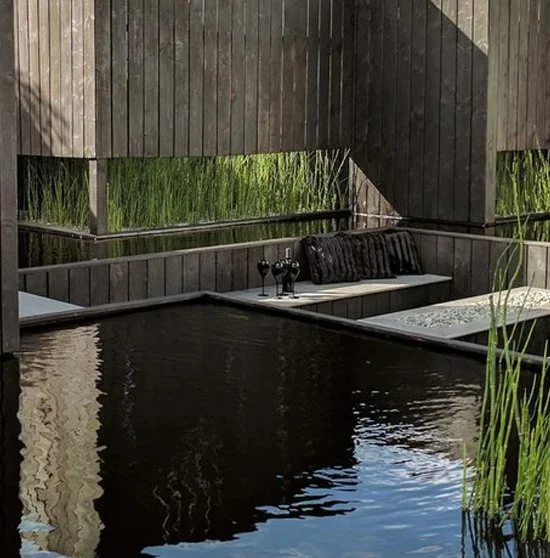
![Bespoke water features in Wigan]()
Bespoke water features in Wigan
-
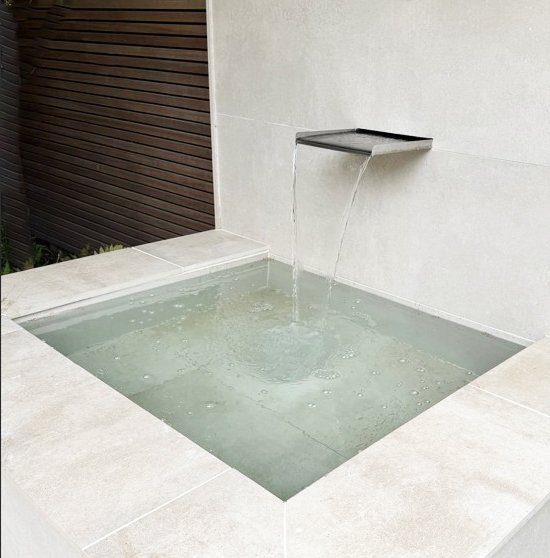
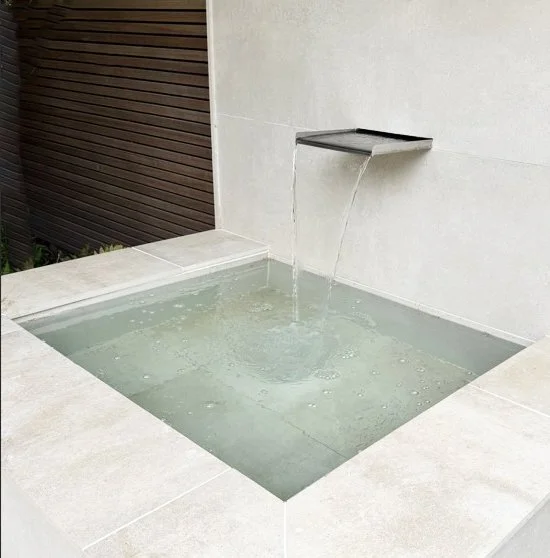
![Porcelain and letterbox style water feature in Wigan]()
Porcelain and letterbox style water feature in Wigan
-
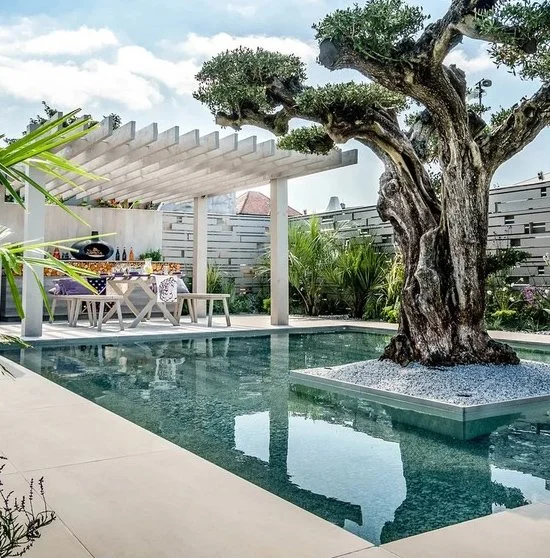
![Contemporary water feature in Wigan]()
Contemporary water feature in Wigan
-
![Bespoke water feature in Wigan]()
Bespoke water feature in Wigan
-
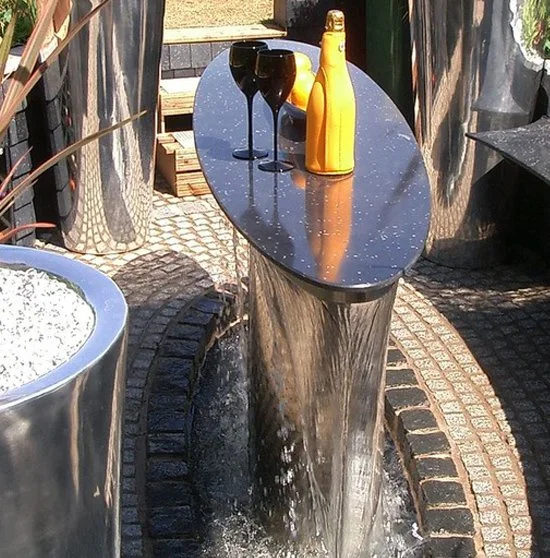
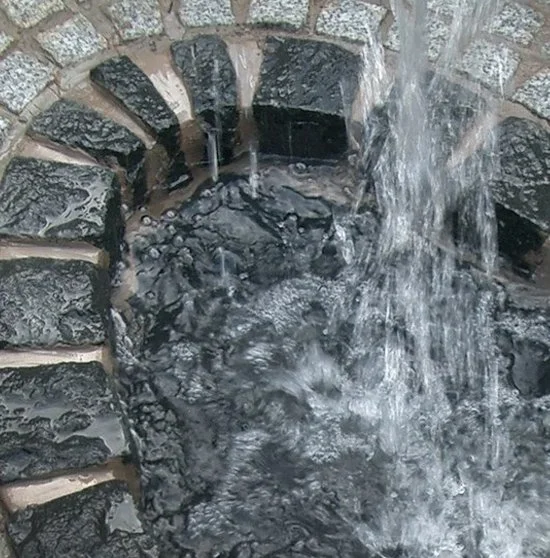
![Granite and steel letterbox style water feature in Wigan]()
Granite and steel letterbox style water feature in Wigan
-
![Bespoke water feature in Wigan]()
Bespoke water feature in Wigan
-
![Premium water feature in Wigan]()
Premium water feature in Wigan
-
![Stainless Steel Water Feature in Wigan]()
Stainless Steel Water Feature in Wigan
-
![Water feature installation in Wigan]()
Water feature installation in Wigan
-
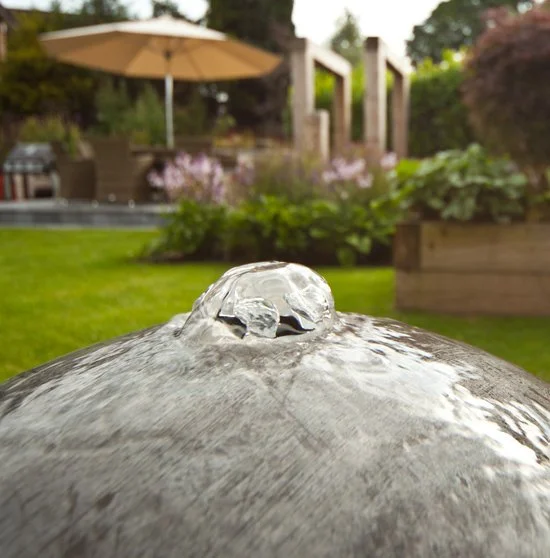
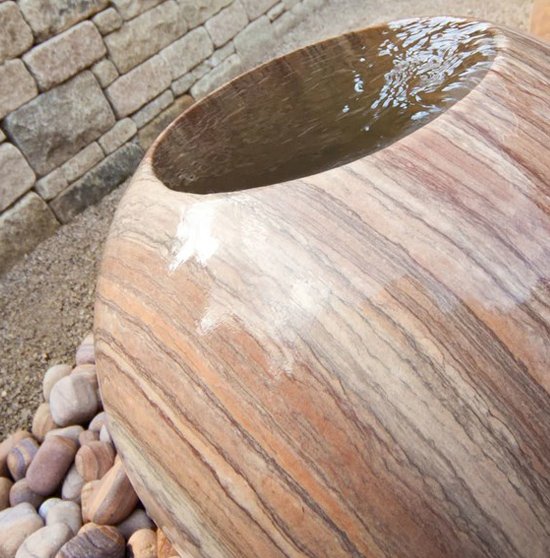
![Granite sphere water feature in Wigan]()
Granite sphere water feature in Wigan
-
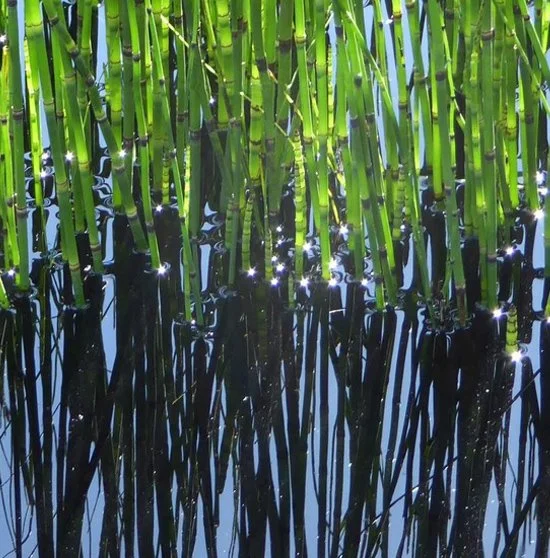
![Water feature with Equisetum feature in Wigan]()
Water feature with Equisetum feature in Wigan
-
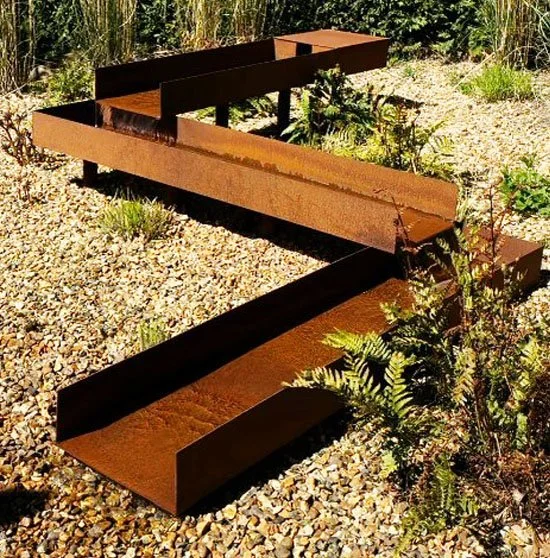
![Corten Steel water feature rill in Wigan]()
Corten Steel water feature rill in Wigan
01204 471040
wigan@landscapingemporium.co.uk
Garden Water Features in Wigan
There is no single type of water feature that works in every garden.
The scale of the garden, architectural style of the property, surrounding materials, planting, available space and the way you intend to use the garden should all influence the choice.
A large dramatic feature can look spectacular in the right setting but overpower a smaller garden.
Equally, a feature that is too small can disappear visually within a substantial landscape.
Our approach is therefore to consider the water feature as part of the overall garden composition, rather than treating it as an isolated ornament.
We can supply and install water features for gardens across Wigan and surrounding areas including Standish, Shevington, Winstanley, Orrell, Billinge, Haigh, Aspull, Hindley, Atherton, Leigh, Wrightington and nearby parts of the North West.
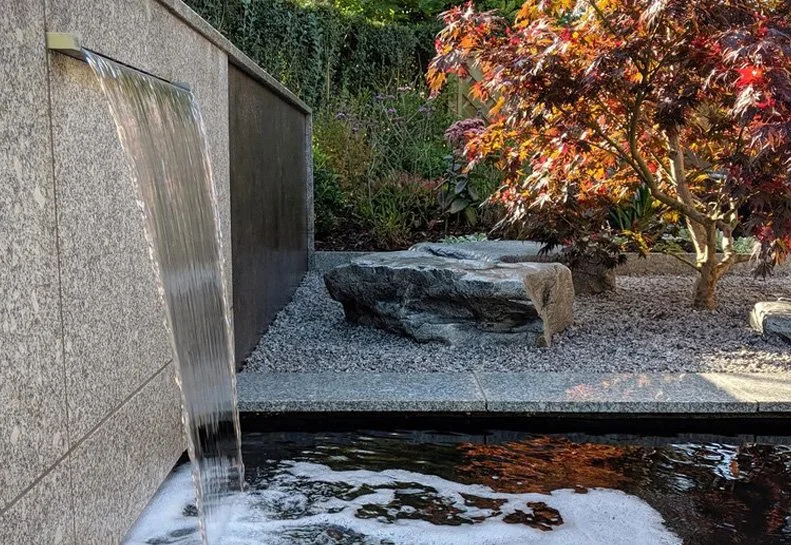
Water Feature Design in Wigan
The best water features usually begin with deciding what you want the water to achieve.
Do you want sound?
Movement?
Reflection?
A focal point?
Wildlife?
Something dramatic when viewed from inside the house?
Or simply a subtle feature that adds atmosphere to a seating area?
Those objectives can lead to very different designs.
A bubbling stone or water bowl produces a completely different effect from a long reflective pool.
A stainless-steel water wall creates a different character again.
Understanding the purpose of the feature before selecting the product or materials generally produces a much stronger result.
Contemporary Water Features
Contemporary water features work particularly well with modern properties, extensions and gardens using porcelain paving, architectural planting and clean geometric lines.
Materials such as stainless steel, Corten steel, porcelain and natural stone can all be incorporated into contemporary designs.
The water itself may bubble gently from a central outlet, cascade down a wall, flow along a narrow rill or create a completely still reflective surface.
The surrounding design is just as important as the feature.
Repeating materials already used elsewhere in the garden can make the water feature feel integrated rather than added afterwards.
Why not take a look at the Kirman Design portfolio.
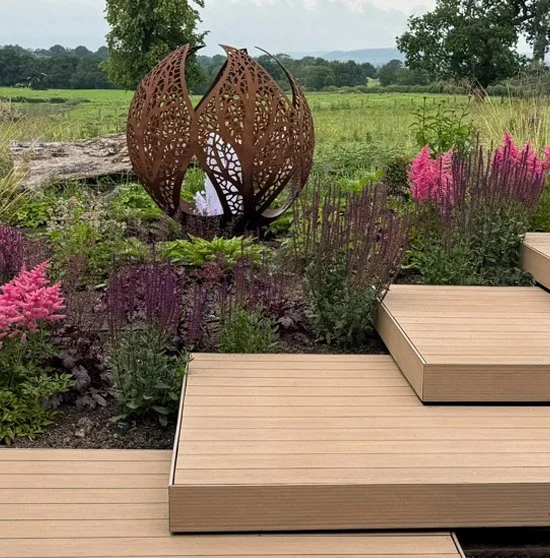
Corten steel water feature in Wigan
Sandstone ball water feature in Wigan
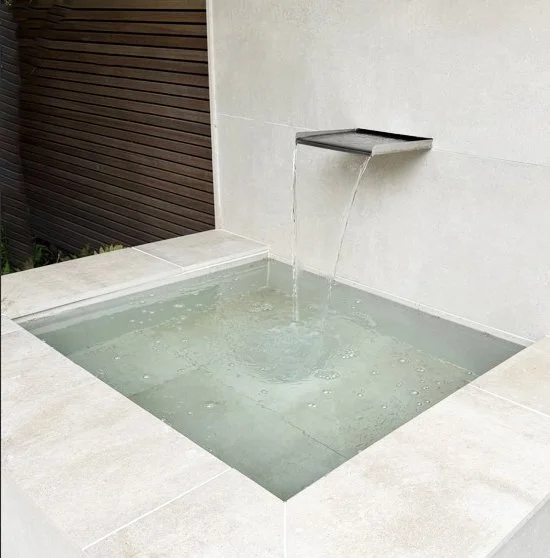
Bespoke water feature pool in Wigan
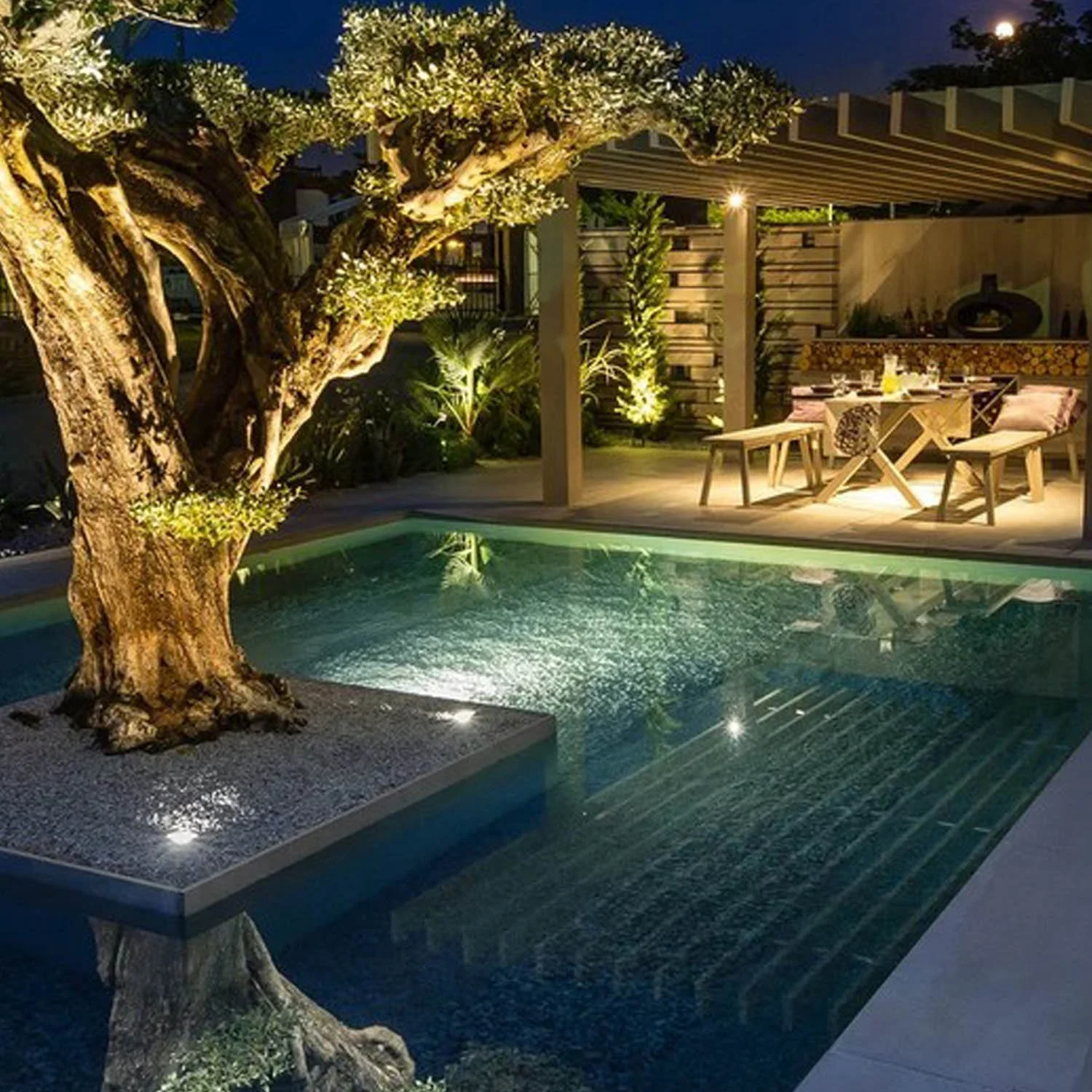
Water feature design in Wigan
Bespoke Water Features
Sometimes an off-the-shelf feature is not quite right for the space.
A bespoke water feature can be designed specifically around the proportions and materials of the garden.
This could include a raised water wall, a letterbox-style cascade, a formal pool, a rill, a reflective feature or a combination of water with planting and lighting.
Bespoke design becomes particularly valuable when the water feature occupies an important position in the garden.
For example, if it is directly visible through large windows or bifold doors, its dimensions and position can be designed around the view from inside the house.
This creates a stronger relationship between the garden and the property.
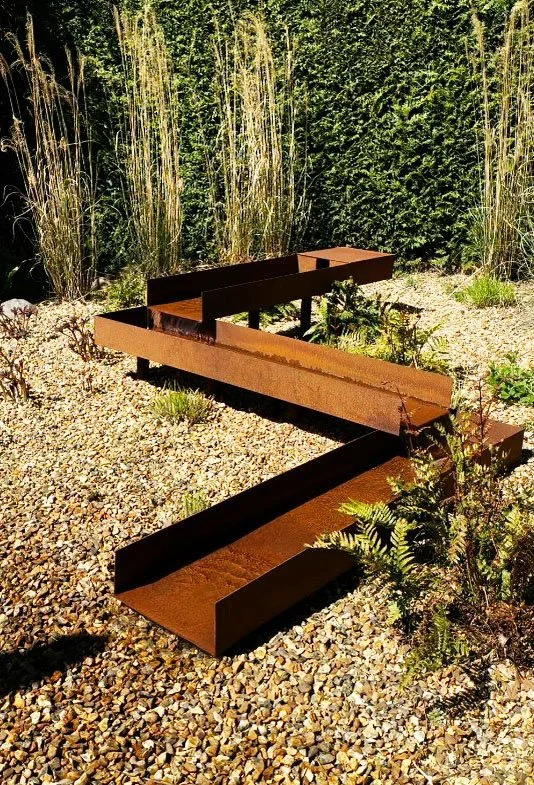
Corten Steel Water Features
Corten steel works extremely well in contemporary and naturalistic gardens.
As the steel weathers, it develops its distinctive rust-coloured protective surface.
The warm tones work particularly well alongside green planting, ornamental grasses, natural stone and darker contemporary materials.
Corten can be used for water bowls, walls, rills and bespoke features.
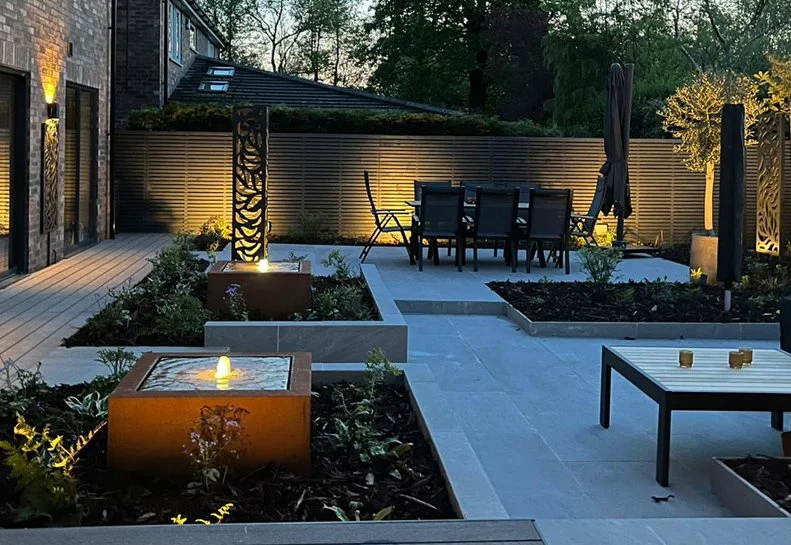
When combined with moving water and appropriate lighting, it can become a striking feature both during the day and after dark.
Stainless Steel Water Features
Stainless steel creates a cleaner and more contemporary appearance.
It works particularly well with modern architecture and gardens using porcelain paving or other crisp hard-landscape materials.
Water can be directed over stainless-steel surfaces to create sheets, cascades or narrow streams.
The reflective properties of the material can also interact particularly well with garden lighting.
Stone Water Features
Natural stone creates a softer and often more timeless appearance.
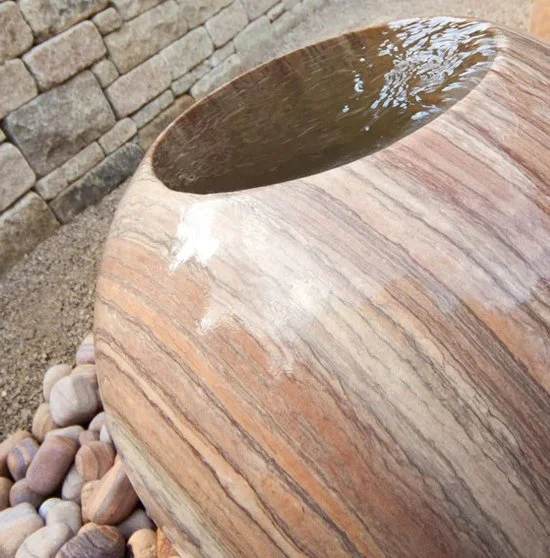
Stone spheres, monoliths and drilled boulders can introduce water without making the garden feel overly formal.
The natural variation within the stone means every feature has its own character.
Stone works particularly well within traditional gardens, country gardens and planting-led landscapes, although simple stone forms can also look extremely effective in contemporary spaces.
Water Bowls and Bubbling Features
A bubbling water bowl can be one of the simplest ways to introduce water into a garden.
Rather than producing a large waterfall or pool, water gently moves across the surface or bubbles from a central point.
This can provide movement and sound without dominating the space.
Water bowls are particularly useful beside patios, within planting schemes and in smaller gardens where there may not be room for a substantial built water feature.
Water Walls
A water wall allows water to become a strong vertical feature.
This can be particularly useful where garden space is limited.
Rather than occupying a large amount of ground, the feature can be incorporated against or within a wall.
Water walls can be designed using stone, porcelain, stainless steel and other suitable materials depending on the style of the garden.
They can also help introduce gentle background sound around seating and entertaining areas.
Letterbox Water Features
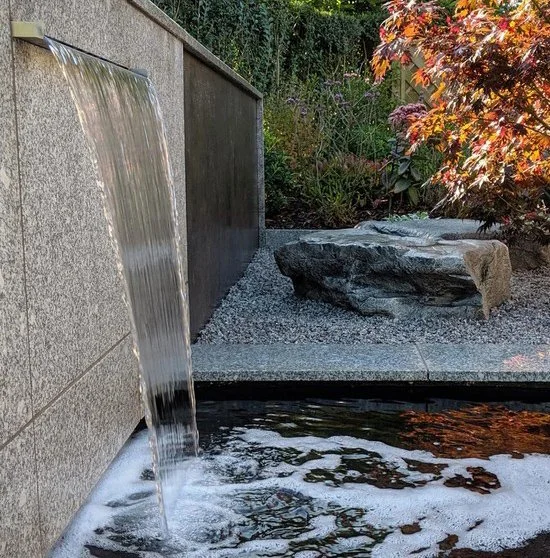
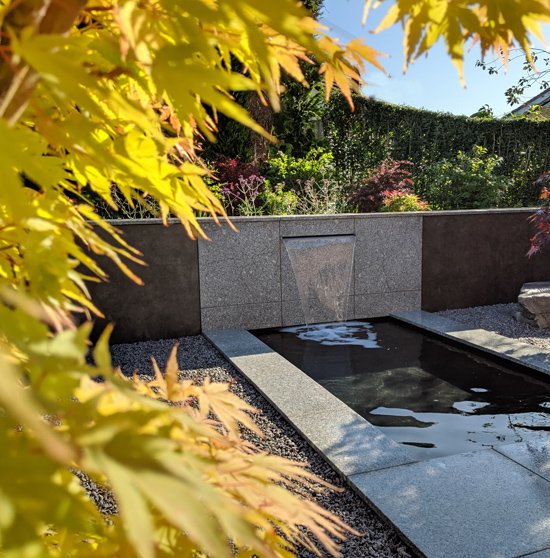
A letterbox water feature produces a controlled sheet of water from a narrow horizontal outlet.
It can be incorporated into a raised wall with a reservoir or pool beneath.
This type of feature works particularly well in formal and contemporary gardens because the geometry can be coordinated with walls, paving and other architectural elements.
The width and drop of the water can be adjusted to suit the scale of the feature.
“Great service, skilled workers, good timing and communications throughout. Reasonable pricing for the work we had done which was an overall concept design and some of the hard landscaping, new driveway and block paving, patios, retaining wall and paths and grading the garden to level. Would recommend.”
Stainless Steel Water Features
Stainless steel creates a cleaner and more contemporary appearance.
It works particularly well with modern architecture and gardens using porcelain paving or other crisp hard-landscape materials.
Water can be directed over stainless-steel surfaces to create sheets, cascades or narrow streams.
The reflective properties of the material can also interact particularly well with garden lighting.
Stone Water Features
Natural stone creates a softer and often more timeless appearance.
Stone spheres, monoliths and drilled boulders can introduce water without making the garden feel overly formal.
The natural variation within the stone means every feature has its own character.
Stone works particularly well within traditional gardens, country gardens and planting-led landscapes, although simple stone forms can also look extremely effective in contemporary spaces.
Water Bowls and Bubbling Features
A bubbling water bowl can be one of the simplest ways to introduce water into a garden.
Rather than producing a large waterfall or pool, water gently moves across the surface or bubbles from a central point.
This can provide movement and sound without dominating the space.
Water bowls are particularly useful beside patios, within planting schemes and in smaller gardens where there may not be room for a substantial built water feature.
Water Walls
A water wall allows water to become a strong vertical feature.
This can be particularly useful where garden space is limited.
Rather than occupying a large amount of ground, the feature can be incorporated against or within a wall.
Water walls can be designed using stone, porcelain, stainless steel and other suitable materials depending on the style of the garden.
They can also help introduce gentle background sound around seating and entertaining areas.
Letterbox Water Features
A letterbox water feature produces a controlled sheet of water from a narrow horizontal outlet.
It can be incorporated into a raised wall with a reservoir or pool beneath.
This type of feature works particularly well in formal and contemporary gardens because the geometry can be coordinated with walls, paving and other architectural elements.
The width and drop of the water can be adjusted to suit the scale of the feature.
Garden Rills
A rill introduces water as a linear element through the garden.
Rather than acting as a single object, it can become part of the structure of the landscape.
A rill might run alongside a path, connect different garden areas or lead the eye towards another focal point.
In larger gardens, rills can be particularly effective because they introduce movement and reflection over a greater distance.
They can be formal and architectural or softened with surrounding planting.
Reflective Pools
Water does not have to move.
A still or gently moving pool can create reflections of the sky, planting, trees and surrounding architecture.
This can add apparent depth to the garden and create a very different atmosphere from a cascading feature.
Reflective pools work particularly well where the garden has strong architectural lines or specimen planting worth reflecting.
Positioning is critical.
The feature should be designed around what will actually appear in the reflection when viewed from important positions within the house and garden.
Water Features for Small Gardens
A small garden can benefit enormously from water, but scale becomes particularly important.
A compact bubbling feature, narrow water wall, small bowl or vertical feature may be more appropriate than a large pond or pool.
Vertical water features are particularly useful because they can provide significant visual impact without using much floor space.
Sound also needs consideration.
A powerful cascade positioned beside a small seating area may be overwhelming, whereas gentle bubbling water can create a much calmer atmosphere.
Water Features for Large Gardens
Larger gardens provide opportunities for more substantial water features.
Long rills, larger reflective pools, bespoke waterfalls and architectural water walls can be integrated into the overall garden structure.
The feature may also form part of a sequence through the garden rather than existing as a single isolated object.
In a large landscape, proportion becomes particularly important.
A feature that looks substantial in a showroom can appear surprisingly small once placed within a large garden.
Water Features Around Patios
Patios and seating areas are some of the best locations for water features.
The feature can be seen and heard while the area is being used.
A water wall can provide a focal point beyond a dining table.
A bubbling bowl can sit within surrounding planting.
A narrow rill might define the edge of a terrace.
Water can also introduce sound that helps soften background traffic and other everyday neighbourhood noise.
The important consideration is balance. The sound should contribute to the atmosphere rather than overpower conversation.
Water Features for Outdoor Entertaining Areas
Water can help create a stronger sense of destination within an outdoor entertaining area.
A carefully positioned feature gives the eye somewhere to rest and can provide movement after other parts of the garden become visually still.
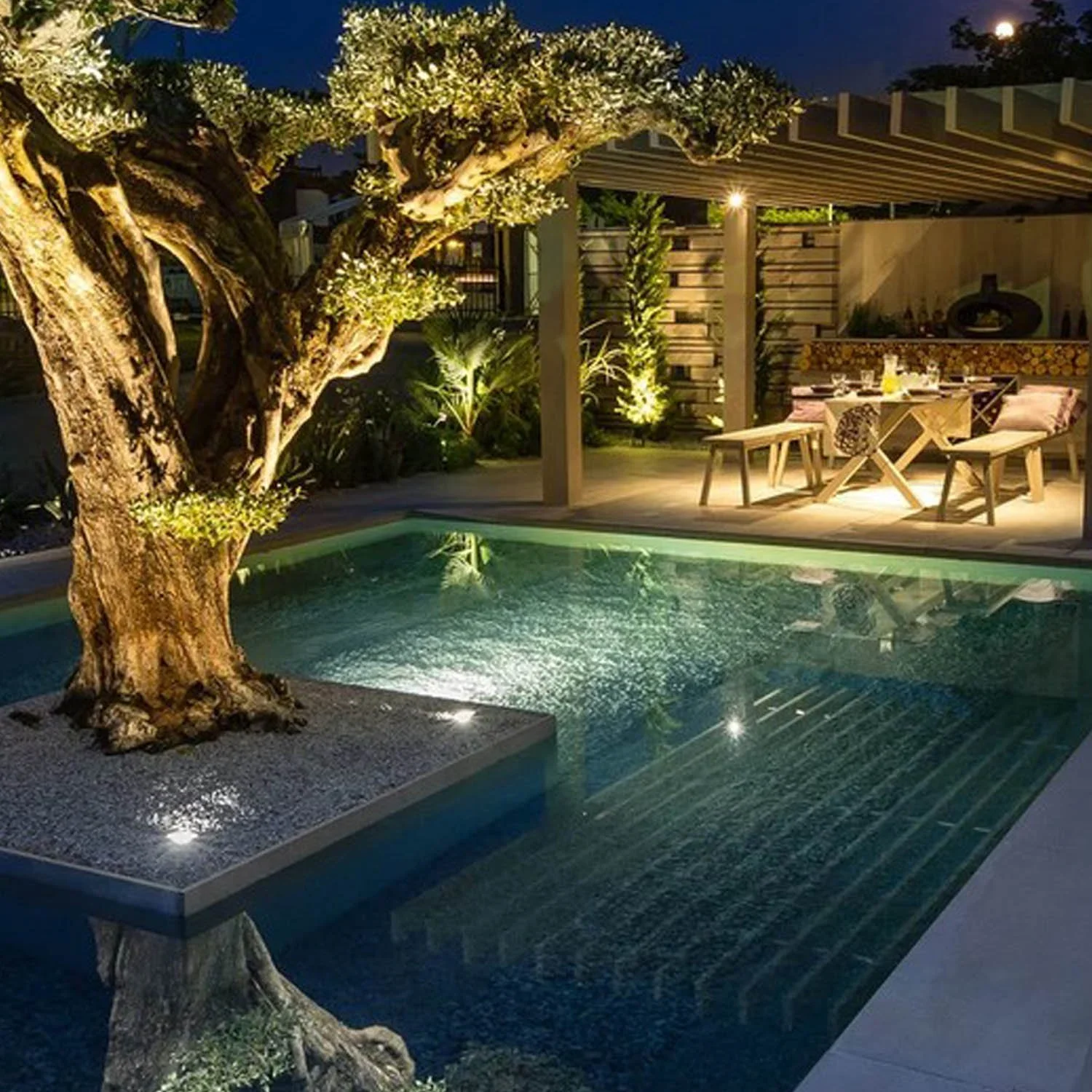
When combined with lighting, the effect can become particularly strong in the evening.
This makes water features especially effective around outdoor kitchens, dining areas, fire pits and garden lounges.
Water Features and Garden Lighting
Water and lighting work exceptionally well together.
Light can emphasise movement, illuminate falling water and create reflections across still surfaces.
A feature that is relatively understated during the day can become one of the strongest visual elements in the garden after dark.
Lighting should ideally be considered when the water feature is being designed rather than added as an afterthought.
Cable routes, transformer positions, viewing angles and glare can then be considered before construction is complete.
Water Features and Planting
Planting can completely change the character of a water feature.
Architectural grasses can soften contemporary steel.
Ferns and shade-tolerant planting can create a cooler woodland character.
Perennials can introduce seasonal colour around a pool or rill.
Emergent and aquatic plants may also be appropriate for certain types of feature.
The relationship between planting and water should therefore be considered as part of the design rather than treating them as separate elements.
Water Features for Wildlife
Water can increase the ecological value of a garden, but different water features offer very different wildlife benefits.
A deep formal feature with vertical sides has a different ecological role from a shallow wildlife pond with planted margins.
If wildlife is a priority, this should be established during the design stage.
Safe access and escape points, water depth, planting and the use of pumps or filtration can all influence the habitat value.
A decorative water feature can attract birds and insects, but a dedicated wildlife pond should be designed specifically for that purpose.
Can a Water Feature Help Mask Traffic Noise?
Moving water can help make unwanted background noise less noticeable.
The effect depends on the amount and character of the water movement.
A gentle bubble creates subtle sound.
A cascade or falling sheet of water creates a stronger sound.
The objective is generally not to eliminate traffic or neighbourhood noise completely but to introduce a more pleasant sound that competes with it.
The feature should be positioned where the sound will be useful, particularly around seating areas.
Water Feature Installation in Wigan
A successful water feature installation involves more than positioning the visible feature.
Depending on the design, the installation may involve excavation, foundations, reservoirs, pumps, pipework, drainage, electrical provision, paving and surrounding landscaping.
Access also matters.
Large stone features, reservoirs and bespoke structures can be extremely heavy.
The route from the road to the installation position should therefore be considered before products are ordered.
Our team can assess how the feature will be incorporated into the garden and what preparation is required for the installation.
Pumps and Water Circulation
Most moving water features require a pump to circulate water from the reservoir back through the feature.
The pump needs to be correctly sized for the required water movement and height.
A small bubbling feature requires very different circulation from a wide sheet of falling water.
Access to the pump should also be considered.
Designing a beautiful water feature that requires major dismantling every time the pump needs attention is poor planning.
Maintenance access should be incorporated from the beginning.
Electrical Requirements
Many pumped water features require an electrical supply.
Where mains electrical work is necessary, this should be undertaken by an appropriately qualified electrical installer.
The location of cables, connections and controls should be considered before surrounding paving and landscaping are completed.
Planning the water feature early in a garden project can therefore avoid unnecessary disruption later.
Do Water Features Need a Water Supply?
Many recirculating garden water features do not require a permanent mains water supply.
The same water is circulated repeatedly through the feature.
However, water can be lost through evaporation and splash, particularly during warm or windy weather, so periodic topping up may be necessary.
Larger bespoke installations may have different requirements.
The water and electrical arrangements should therefore be established for the specific feature being installed.
Do Water Features Need Drainage?
Not necessarily, but drainage and overflow need to be considered.
Heavy rainfall can raise the water level within an external feature.
The design should therefore account for what happens when the reservoir or pool becomes full.
The correct solution depends on the construction and location of the feature.
This is another reason to consider the water feature as part of the wider garden drainage strategy.
Water Feature Maintenance
No water feature is completely maintenance-free.
Typical maintenance may include removing leaves and debris, checking water levels, cleaning the pump and filters where applicable and occasionally cleaning surfaces.
The amount of maintenance depends heavily on the design.
A small self-contained water feature may require relatively little attention.
A larger pool surrounded by deciduous trees may require considerably more.
If low maintenance is a priority, say so at the design stage.
Algae in Garden Water Features
Algae can develop where water, light and nutrients create suitable conditions.
The likelihood varies according to the type of feature, sunlight, water movement and maintenance.
Rather than assuming algae can be permanently eliminated, the water feature should be designed so that routine cleaning is practical.
The appearance of the materials also matters.
Some natural weathering and biological development may be acceptable in a naturalistic stone feature but less desirable in a crisp contemporary reflective pool.
Water Features in Winter
Winter requirements depend on the feature and equipment installed.
Pumps and pipework can be vulnerable to freezing conditions, while water expansion can affect certain components and materials.
Some features may need to be drained or pumps removed during severe cold, while others can remain operational according to the manufacturer's instructions.
The maintenance requirements should be understood when choosing the feature.
Choosing the Right Position
Position can make or break a water feature.
Consider how the feature will be viewed from the house.
Can it be seen from the kitchen, dining room or living room?
Will it become the focal point at the end of a path?
Will you hear it from the main seating area?
Could surrounding trees create excessive leaf fall?
Will it receive full sun throughout the day?
Is there practical access for installation and maintenance?
A well-positioned modest feature can have much greater impact than an expensive feature placed in the wrong location.
Designing a Water Feature Around the View From the House
One of the most effective approaches is to begin inside the property.
Important views from kitchen windows, sliding doors, bifold doors and living spaces can establish where the water feature should sit.
The feature can then form a focal point at the end of that sightline.
This means the garden continues to provide interest even when it is being viewed from indoors.
Lighting can extend that effect into the evening and throughout winter.
Water Features as Part of a Complete Garden Design
A water feature becomes particularly effective when it is considered at the same time as paving, planting, lighting and other garden elements.
Its dimensions can relate to the paving grid.
Its material can repeat a wall or edging material.
Planting can frame it.
Lighting can reveal it after dark.
Rather than appearing as an object placed in the garden, the feature becomes part of the architecture of the space.
This is where Kirman Design's wider garden design and landscaping experience supports the Landscaping Emporium installation service.
Retrofitting a Water Feature Into an Existing Garden
You do not need to redesign the entire garden to introduce water.
Many features can be incorporated successfully into an existing landscape.
The key is understanding the existing materials, levels, electrical provision and access.
A self-contained feature may require relatively little disruption.
A bespoke rill, pool or water wall can involve considerably more construction.
We can assess what is practical before recommending the appropriate approach.
Water Feature Replacement and Garden Renovation
An old or unsuccessful water feature can sometimes be replaced as part of a wider garden renovation.
Existing pools may be redesigned.
Outdated features can be removed.
New materials and planting can be introduced around the area.
In some cases, the existing structure may be reusable; in others, starting again produces a better long-term result.
The condition of the existing installation needs to be assessed before deciding.
How Much Does a Water Feature Cost in Wigan?
The cost varies enormously because “water feature” can describe anything from a relatively simple self-contained product to a completely bespoke constructed installation.
The main factors include the feature itself, excavation, foundations, reservoir size, pumps, electrical requirements, access, surrounding paving, walls, lighting and planting.
For that reason, meaningful pricing needs to reflect the actual feature and installation conditions.
A simple feature on an existing prepared surface is fundamentally different from a bespoke water wall or rill constructed as part of a landscaped garden.
Choosing a Water Feature Installer in Wigan
When comparing installers, look beyond the visible product.
Consider who will assess the site, prepare the base, deal with levels, integrate the feature with paving and planting and coordinate any necessary electrical work.
Also consider how future maintenance access will work.
A water feature needs to look good on completion, but it should also remain practical to own.
Experience in garden construction and design is particularly valuable where the feature is being integrated into a wider landscaped space.
Why Choose Landscaping Emporium for Your Wigan Water Feature?
Landscaping Emporium is brought to you by Kirman Design, combining carefully selected garden products with professional garden design and landscaping experience.
That allows us to look beyond simply supplying a water feature.
We can consider position, scale, materials, installation, paving, planting, lighting and the relationship with the wider garden.
For customers who already know exactly what they want, we can help with supply and suitable installation.
For more complex projects, the water feature can be developed as part of a broader garden design.
Water Feature Installation Areas Around Wigan
Our water feature installation service covers Wigan and surrounding areas, including Standish, Shevington, Winstanley, Orrell, Billinge, Haigh, Aspull, Hindley, Atherton, Leigh and Wrightington, subject to the individual project and installation requirements.
We also undertake suitable garden projects across wider areas of Greater Manchester, Lancashire, Merseyside, Cheshire and the North West.
Frequently Asked Questions About Water Features in Wigan
Do you install garden water features in Wigan?
Yes. Landscaping Emporium can supply and professionally install suitable garden water features in Wigan and surrounding areas.
Do you design bespoke water features?
Yes. More complex water features can be designed around the garden, architecture, available space and the effect you want to achieve.
Can you install a water feature in an existing garden?
Yes. Many water features can be retrofitted into existing gardens, although the amount of work required depends on the feature, access, existing surfaces and electrical requirements.
What type of water feature is best for a small garden?
Compact water bowls, bubbling features and vertical water walls can work particularly well because they create movement and sound without occupying excessive space.
What type of water feature is best for a contemporary garden?
Corten steel, stainless steel, porcelain, architectural stone, water walls, rills and reflective pools can all work extremely well in contemporary gardens.
Can you install a water feature beside a patio?
Yes. Patios and seating areas are often excellent positions because the feature can be seen and heard while the garden is being used.
Can a water feature help disguise road noise?
Moving water can introduce a more pleasant foreground sound that makes traffic and neighbourhood noise less noticeable, although it does not physically eliminate the external noise.
Does a water feature need electricity?
Most features using pumps require electricity. The precise requirements depend on the product and installation.
Does a water feature need mains water?
Many garden water features recirculate the same water and do not require a permanent mains supply, although they may need topping up.
Are garden water features difficult to maintain?
It depends on the design. A simple self-contained feature may require relatively little maintenance, while larger pools and complex installations require more regular attention.
Can you add lighting to a water feature?
Yes. Lighting can be incorporated into or around suitable water features and can create a particularly strong effect after dark.
Can you incorporate planting around a water feature?
Yes. Planting is often an important part of integrating the feature into the wider garden.
Can a water feature attract wildlife?
Yes. Water can attract birds and insects, although a decorative water feature and a purpose-designed wildlife pond provide different types of habitat.
Can you install Corten steel water features in Wigan?
Yes, subject to the specific product, garden and installation requirements. Corten steel can work particularly well in contemporary and naturalistic gardens.
Can you install stainless-steel water features?
Yes. Stainless steel is particularly effective for contemporary water walls, cascades and other architectural features.
Can you install stone water features?
Yes. Natural stone spheres, monoliths and other stone features can be incorporated into both traditional and contemporary garden designs.
Do you install water rills and reflective pools?
Bespoke rills and reflective pools can be considered as part of appropriate garden design and landscaping projects.
Can the water feature be designed around my view from the house?
Yes. In many gardens this is one of the best ways to position the feature. Important views through windows and doors can be used to establish the focal point.
Do you work outside Wigan?
Yes. Suitable supply and installation projects can be undertaken across other parts of North West England.
Water Features Supplied and Installed in Wigan
If you are considering adding water to your garden, Landscaping Emporium can help you select a feature that suits the garden, property, available space and budget, rather than simply choosing a product in isolation.
From bubbling bowls and stone features to contemporary Corten steel installations, water walls, rills and bespoke pools, we can help develop the right solution.
Professional installation is available for suitable projects in Wigan, Standish, Shevington, Winstanley, Orrell, Billinge, Haigh, Aspull, Hindley, Atherton, Leigh, Wrightington and surrounding areas.
Talk to Us About Your Water Feature
To help us understand the project, send us your postcode, photographs of the garden, approximate dimensions of the proposed area and an indication of the type of water feature you like.
If you have inspiration images, send those too.
It is also useful to tell us whether you are looking for supply only, installation, a bespoke water feature or a wider garden design and landscaping project.
We can then advise on the most appropriate next step for your Wigan garden.
Should you have any questions, please feel free to contact our support team with the contact form below:
Social Media
Office opening hours
Monday: 08:00 - 16:00
Tuesday: 08:00 - 16:00
Wednesday: 08:00 - 16:00
Thursday: 08:00 - 16:00
Friday: 08:00 - 16:00
An answering service is in operation outside these hours so please leave a message and will get back to you presently.
Telephone