
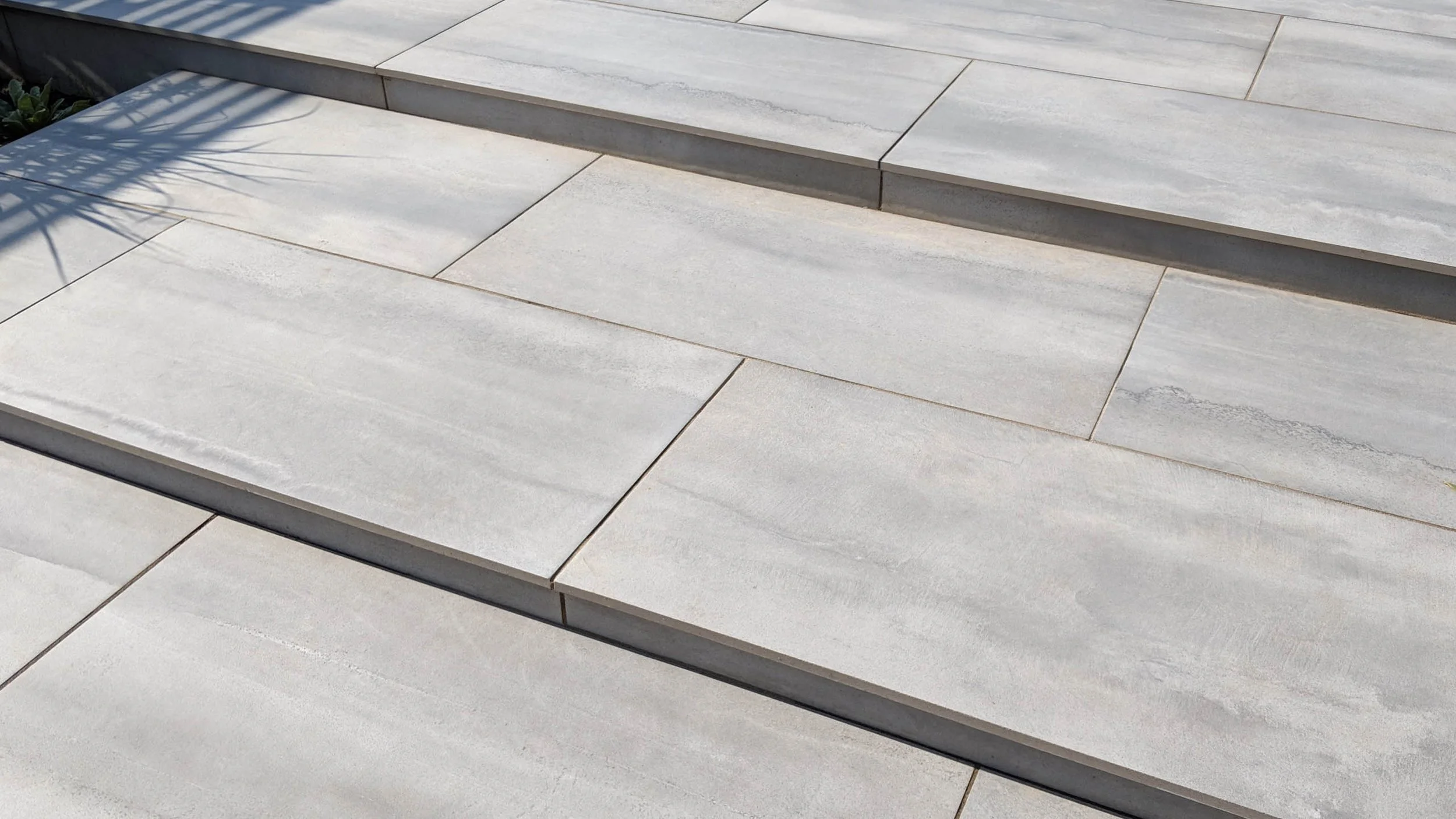
Porcelain
FAQ
Frequently asked questions.
Porcelain Paving FAQs
Porcelain paving has become one of the most popular materials for modern patios, combining a refined appearance with durability, low water absorption and relatively straightforward maintenance.
But choosing the right porcelain involves more than deciding which colour you prefer.
Customers regularly ask us about slip resistance, frost, cleaning, scratches, installation, jointing, drainage, colour variation and how porcelain performs in the wet climate of North West England.
This guide answers those questions and explains what you should consider before choosing porcelain for your garden.
If you are looking for paving for a new patio, explore our Paving & Patios collection.
What Is Porcelain Paving?
Porcelain paving is manufactured from refined clay and other natural materials that are fired at very high temperatures.
This process produces an extremely dense material with very low water absorption.
Unlike natural stone, where every slab has been formed geologically, porcelain is manufactured under controlled conditions. This gives manufacturers much greater control over dimensions, colour, texture and surface characteristics.
Modern outdoor porcelain can recreate the appearance of stone, concrete and other materials while retaining the technical characteristics associated with porcelain.
What Are the Benefits of Porcelain Paving?
Porcelain combines several characteristics that make it particularly suitable for patios.
Its very low water absorption means that moisture has relatively little opportunity to penetrate the slab. This contributes to good frost resistance and makes the material comparatively resistant to staining.
Porcelain is also available in an enormous range of colours and finishes, allowing it to work with everything from contemporary extensions to more traditional properties.
For many customers, however, one of the biggest advantages is maintenance.
A correctly installed porcelain patio can provide a clean, consistent surface that is relatively straightforward to look after.
What Are the Disadvantages of Porcelain Paving?
Porcelain is not necessarily the perfect material for every garden.
If you want genuine geological variation, natural weathering and the patina associated with real stone, porcelain may feel too controlled.
It is also a material that needs to be installed correctly.
Porcelain is extremely dense, which means installation techniques differ from those traditionally used for some natural stone paving. Appropriate cutting equipment, bedding, bonding, drainage and jointing are important.
A good-quality porcelain slab installed badly will not create a good patio.
Installation should therefore be considered part of the product rather than an afterthought.
Is Porcelain Paving Better Than Natural Stone?
Neither is automatically better.
They create different types of patio.
Porcelain is particularly attractive where you want low water absorption, colour consistency, clean lines and relatively straightforward maintenance.
Natural stone is attractive where you value genuine variation, texture and the way a natural material changes as it ages.
The architecture of the property should influence the decision too.
A contemporary extension with large areas of glass can work beautifully with porcelain, while an older stone property may benefit from the character of natural paving.
For broader questions covering both materials, see our Stone & Paving FAQs.
Is Porcelain Suitable for Outdoor Patios?
Yes, provided you choose porcelain specifically intended for external use.
Indoor porcelain tiles and external porcelain paving are not interchangeable simply because they are made from similar materials.
Outdoor paving needs a suitable surface texture, thickness and technical specification for its intended application.
For Landscaping Emporium patio products, we specify outdoor porcelain suitable for external garden use.
Is Porcelain Paving Slippery When Wet?
Outdoor porcelain should be selected with slip resistance in mind.
A smooth internal porcelain tile would clearly be inappropriate for an exposed patio, particularly in the wetter conditions experienced across North West England.
External porcelain is therefore manufactured with textured surfaces designed to improve grip.
Many of the porcelain products we select for outdoor use have an R11 slip-resistance classification.
No paving should be considered completely slip-proof. Leaves, mud, algae, frost and other surface contamination can make virtually any external material slippery.
Regular cleaning remains important.
What Does R11 Mean on Porcelain Paving?
R ratings are commonly used to describe the slip resistance of flooring materials under specified test conditions.
An R11 classification indicates a relatively high level of slip resistance and is commonly seen on porcelain intended for external applications.
It should not be interpreted as a guarantee that the patio can never become slippery.
Surface contamination and environmental conditions still matter.
When choosing outdoor porcelain, slip resistance should therefore be considered alongside the appearance of the product.
Does Porcelain Paving Get Slippery With Algae?
It can.
Porcelain itself absorbs very little moisture, but organic material can still accumulate on the surface.
In a damp, shaded garden, leaves, soil and atmospheric dirt can provide conditions in which algae develops.
The advantage of porcelain is that the growth tends to remain on the surface rather than penetrating deeply into the material, making appropriate cleaning relatively straightforward.
Keeping the patio clear of leaves and organic debris will also help.
Is Porcelain Paving Frost Resistant?
Good-quality external porcelain has very low water absorption, which makes it highly resistant to freeze-thaw conditions.
That is particularly useful in the UK.
However, the slab is only one component of a patio.
Problems can still arise if water is allowed to become trapped within an incorrectly constructed installation.
Correct falls, drainage, bedding and jointing therefore remain important even when the surface material itself has excellent frost resistance.
Is Porcelain Paving Suitable for North West England?
Yes. Porcelain can be an excellent paving material for gardens across Lancashire, Greater Manchester, Cheshire, Merseyside and the wider North West.
Our climate places particular demands on external surfaces because patios can remain wet for prolonged periods and experience repeated seasonal temperature changes.
Porcelain's low water absorption and relatively straightforward cleaning make it particularly attractive in these conditions.
The patio still needs to be constructed correctly.
Drainage and falls are especially important in a region where heavy rainfall is hardly an unusual event.
Does Porcelain Paving Get Hot in the Sun?
All external surfaces can warm up when exposed to prolonged direct sunlight.
Colour has a significant influence.
Dark paving generally absorbs more solar energy than pale paving and may therefore feel warmer underfoot on a hot sunny day.
If the patio is in a very sunny position and people are likely to walk barefoot regularly, a lighter porcelain may be worth considering.
For most North West gardens, excessive surface temperature is not normally one of the principal factors determining whether porcelain is suitable.
How Long Does Porcelain Paving Last?
Good-quality external porcelain is an extremely durable material.
Rather than promising a particular number of years, however, we prefer to consider the complete construction.
A porcelain slab may be extremely durable, but the patio still relies upon the ground preparation, sub-base, bedding system, bonding, drainage and jointing beneath and around it.
Correctly specified materials combined with professional installation should provide a long-lasting external surface.
Does Porcelain Paving Fade?
Quality porcelain is highly resistant to colour fading.
The appearance is created during the manufacturing process rather than relying on a simple surface coating.
This makes porcelain particularly attractive where colour consistency is important.
Like any external surface, the paving may temporarily appear different when covered with dirt, algae or atmospheric deposits, but appropriate cleaning should restore its intended appearance.
Does Porcelain Paving Vary in Colour?
Yes, although generally much less than natural stone.
Because porcelain is manufactured, colour and pattern can be controlled to a much greater degree.
However, different production batches can have subtle differences in tone.
This becomes important if you decide to extend the patio several years later.
Even if exactly the same product remains available, a new batch may not perfectly match the original paving.
Is Every Porcelain Slab Exactly the Same?
Not necessarily, and that is usually intentional.
Porcelain designed to recreate natural materials often incorporates several different printed faces or pattern variations.
This prevents the finished patio from looking obviously repetitive.
When the patio is being installed, different slab faces should be mixed thoughtfully so that identical or very similar patterns are not unnecessarily grouped together.
Does Porcelain Paving Scratch?
Porcelain is highly resistant to everyday scratching.
Normal use with garden furniture, tables and chairs should not generally present a problem.
However, no surface should be considered completely indestructible.
Dragging very heavy objects or abrasive materials across the patio can potentially mark the surface.
Lifting furniture rather than dragging it and using suitable pads beneath particularly heavy items is sensible practice.
Can Porcelain Paving Crack?
Yes, although properly manufactured porcelain is extremely strong.
Cracking is more likely to result from significant impact, movement or problems within the patio construction than from ordinary pedestrian use.
This is another reason why the preparation beneath the paving is so important.
The finished patio needs a stable and correctly constructed base.
Is Porcelain Paving Low Maintenance?
Yes, relatively speaking.
This is one of porcelain's major advantages.
Because it absorbs very little moisture, dirt and staining tend to remain nearer the surface than they would with some porous materials.
That does not make a porcelain patio maintenance-free.
Leaves, soil, food, grease, bird droppings and general garden dirt should still be removed, while damp shaded areas may occasionally require treatment for algae.
Think low maintenance rather than no maintenance.
How Do I Clean Porcelain Paving?
Routine cleaning can often be carried out using a brush and clean water.
Where additional cleaning is required, use a product suitable for external porcelain and follow the manufacturer's instructions.
Avoid assuming that every powerful patio-cleaning chemical is suitable.
The cleaning product also needs to be compatible with the jointing material.
For stubborn marks, test the proposed cleaner on a small inconspicuous area before treating the whole patio.
Can I Pressure-Wash Porcelain Paving?
Yes, but use appropriate care.
The porcelain itself is extremely robust, but high-pressure water directed aggressively into the joints may damage some jointing products.
The pressure washer should therefore be used sensibly rather than positioning the nozzle extremely close to the surface and joints.
Follow the recommendations for the particular paving and jointing system used.
Does Porcelain Paving Need Sealing?
Porcelain generally does not require sealing in the way that some porous natural stones may.
Its very low porosity is one of its principal benefits.
Always follow the manufacturer's recommendations for the particular product because specialist finishes or installation circumstances can have different requirements.
Can I Put Plant Pots on Porcelain Paving?
Yes.
Porcelain is more than capable of supporting normal garden pots and planters.
However, large pots can trap moisture, soil and organic deposits underneath them for prolonged periods.
Using pot feet can improve drainage and airflow while making periodic cleaning easier.
Moving pots occasionally also allows the surface underneath to be inspected and cleaned.
Can I Put Garden Furniture on Porcelain Paving?
Yes.
Tables, chairs, sofas and normal outdoor furniture can all be used on a properly constructed porcelain patio.
Very heavy items should be handled sensibly.
Furniture with narrow metal feet may benefit from protective pads, and heavy furniture should ideally be lifted rather than dragged across the surface.
Can I Put an Outdoor Kitchen on Porcelain Paving?
Yes, provided the patio construction is suitable for the weight involved.
Outdoor kitchens can be considerably heavier than ordinary garden furniture, particularly when stone or porcelain worktops, appliances and masonry elements are incorporated.
Ideally, the position of an outdoor kitchen should therefore be known before the patio is constructed.
This allows the complete installation to be designed around the loads and layout rather than adding a substantial structure afterwards.
Can I Put a Fire Pit on Porcelain Paving?
The answer depends on the fire pit.
Heat, sparks, ash and the construction of the particular appliance need to be considered.
A suitable heat-resistant barrier or base may be required between some fire products and the paving.
Always follow the fire pit manufacturer's installation and clearance instructions rather than assuming that any appliance can simply be placed directly onto the patio.
How Should Porcelain Paving Be Installed?
External porcelain requires a stable, correctly prepared base and an installation system suitable for the product and site.
The precise construction depends on ground conditions and the project, but appropriate excavation, sub-base preparation, bedding, bonding, falls and jointing are all important.
Because porcelain is very dense, it requires appropriate installation techniques to achieve a reliable bond with the bedding material.
This is one reason professional installation can be particularly worthwhile.
Explore our Paving & Patios section if you are interested in paving supplied with professional installation.
Does Porcelain Paving Need a Fall?
Yes.
Outdoor paving needs to shed rainwater.
Porcelain itself absorbs very little water, which makes managing the water across the surface even more important.
A patio should therefore be constructed with an appropriate fall towards a suitable drainage point or
If there are any other questions or queries which you do not see here, then visit the product page of the item that you are interested in and you will find specific information there and if you can’t find the information you need or you need anything else, please feel free to give us a call to find out more on 01942 604976 or drop us a line at hello@landscapingemporium.co.uk.