Landscaping Emporium | Specimen Trees
Architectural Specimen Trees for Contemporary Gardens
Architectural trees create structure, character
and visual impact within a garden.
Their distinctive trunks, sculptural branches,
crown shapes and seasonal features make them
natural focal points in carefully designed
outdoor spaces.
From elegant multi-stem trees and striking
white-barked birches to rounded canopies
and upright formal specimens, architectural
trees bring a strong design element to
both contemporary and traditional gardens.
Explore six distinctive specimen trees,
compare their architectural qualities
and discover how to use them effectively
within your garden design.
Six Architectural Trees for Statement Planting
Each of these trees offers a different
architectural quality, whether through
its trunk, bark, branching structure
or crown shape. Choose a specimen
that complements your garden's scale,
layout and planting style.
![Multi-stem Amelanchier architectural specimen tree]()
Sculptural | Multi-Stem | Seasonal Colour
Multi-Stem Amelanchier
Amelanchier lamarckii
An elegant multi-stem specimen with
naturally sculptural branching,
delicate white spring flowers
and bronze emerging foliage.
Its open structure is particularly
effective in contemporary gardens,
courtyards and naturalistic planting
schemes where the branching form
can be appreciated.
View Multi-Stem Amelanchier →
![Himalayan Birch with striking white bark]()
White Bark | Winter Structure
Himalayan Birch
Betula utilis var. jacquemontii
One of the most striking architectural
trees for winter interest, with
beautiful pale white bark
and an elegant branching structure.
Particularly effective as a single
specimen or planted in groups,
creating contrast against dark
evergreen foliage and contemporary
garden materials.
View Himalayan Birch →
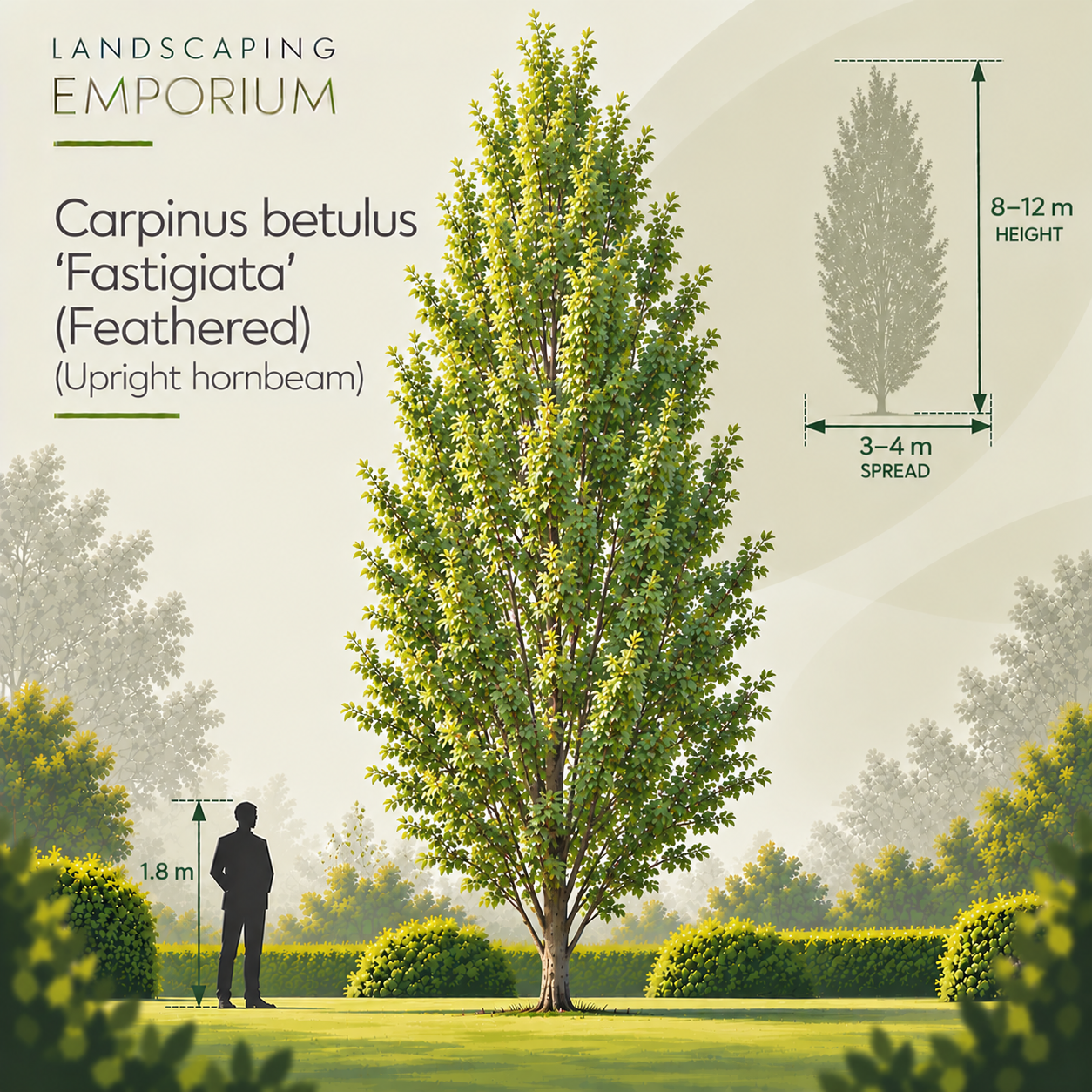
Upright | Formal | Structural
Fastigiate Hornbeam
Carpinus betulus 'Fastigiata'
A strong architectural tree with
an upright, structured habit
that introduces height and rhythm
to formal and contemporary gardens.
Particularly useful for framing
entrances, creating avenues
and providing repetition in
landscape designs. The crown
broadens considerably with age.
View Fastigiate Hornbeam →
![Catalpa Nana with rounded architectural crown]()
Rounded Crown | Formal Design
Dwarf Indian Bean Tree
Catalpa bignonioides 'Nana'
A distinctive ornamental tree
with a naturally dense,
rounded crown and large
heart-shaped leaves.
Excellent for formal garden layouts,
symmetrical planting and contemporary
courtyards. Its broad crown needs
sufficient horizontal space.
View Catalpa 'Nana' →
![Gleditsia Skyline architectural specimen tree]()
Light Canopy | Contemporary
Honey Locust 'Skyline'
Gleditsia triacanthos 'Skyline'
An elegant architectural specimen
with delicate, finely divided
foliage and an attractive
branching framework.
Its relatively light canopy
allows filtered daylight,
making it useful for
contemporary outdoor living
areas and larger garden designs.
View Honey Locust →
![Prunus serrula Tibetan Cherry with polished copper bark]()
Copper Bark | Winter Interest
Tibetan Cherry
Prunus serrula
A distinctive ornamental cherry
valued for its beautiful
polished mahogany-coloured bark,
which provides strong visual
interest during winter.
Its elegant trunk and branching
structure make it an excellent
statement tree in contemporary
and traditional gardens.
View Tibetan Cherry →
What Makes a Tree Architectural?
An architectural tree is selected
primarily for its visual form
and contribution to the overall
garden design.
This may be an unusual branching
structure, a distinctive trunk,
a formal crown shape or
particularly attractive bark.
Architectural trees can create
a focal point, frame a view,
provide repetition or introduce
height and scale to a landscape.
The most successful choice is
one that complements the garden's
proportions and has sufficient
space to develop its natural form.
Compare Architectural Specimen Trees
| Tree |
Architectural Feature |
Garden Style |
Space Considerations |
| Multi-Stem Amelanchier |
Sculptural multi-stem branching |
Contemporary and naturalistic |
Allow for mature crown spread |
| Himalayan Birch |
White bark and elegant trunks |
Modern and woodland |
Allow room for mature height and canopy |
| Fastigiate Hornbeam |
Upright structured form |
Formal and contemporary |
Crown broadens with maturity |
| Catalpa 'Nana' |
Dense rounded crown |
Formal and geometric |
Allow for broad canopy spread |
| Honey Locust 'Skyline' |
Fine foliage and airy canopy |
Contemporary and naturalistic |
Suitable for gardens with substantial space |
| Tibetan Cherry |
Polished copper-mahogany bark |
Contemporary and traditional |
Position where the trunk can be appreciated |
Choosing Architectural Trees for Garden Design
Consider the Tree's Form
Choose between upright,
rounded, spreading and
multi-stem forms according
to the garden's proportions.
Plan for Mature Size
Architectural trees need
sufficient room to develop
their natural crown without
excessive pruning.
Use Repetition Carefully
Matching trees can establish
rhythm, symmetry and visual
continuity within formal
garden designs.
Think About Seasonal Interest
Consider blossom, foliage,
bark and winter branching
to create visual impact
throughout the year.
Multi-Stem Trees for Architectural Impact
Multi-stem trees develop several
principal stems from near ground
level, creating an attractive
sculptural framework.
This form is particularly effective
when the lower branching structure
is visible above low planting
or decorative groundcover.
Amelanchier lamarckii is an
excellent example, combining
elegant stems with white spring
flowers and spectacular autumn colour.
Multi-stem trees work particularly
well beside natural stone paving,
ornamental grasses, water features
and contemporary outdoor seating areas.
Architectural Trees with Striking Bark
Trees with distinctive bark provide
visual interest even when they
have lost their leaves.
Himalayan Birch
The pale white bark of
Betula utilis var. jacquemontii
creates strong contrast against
evergreen planting, dark walls
and winter landscapes.
Tibetan Cherry
Prunus serrula is particularly
valued for its polished,
copper-mahogany bark.
Positioning the tree where
low winter sunlight can
illuminate the trunk can
make this feature especially
striking.
Discover more ideas in our
Trees with Attractive Bark
guide.
Formal Architectural Trees
Formal garden designs often
use repetition, symmetry
and clearly defined shapes
to create a strong visual structure.
Fastigiate Hornbeam can introduce
height and a repeated vertical
rhythm, while Catalpa 'Nana'
provides a distinctive rounded
crown for geometric planting.
When selecting trees for
formal planting, check that
the mature crown dimensions
will remain compatible with
the intended layout.
A tree that looks compact
at the nursery may develop
a much broader canopy
as it matures.
Architectural Trees for Contemporary Gardens
Contemporary garden design often
relies on a limited palette of
materials, strong geometry
and carefully selected focal points.
Architectural trees can soften
hard landscaping while retaining
a clear visual relationship
with the garden's design.
-
Multi-Stem Amelanchier:
A sculptural focal point for
courtyards and contemporary borders.
-
Himalayan Birch:
Bright white trunks contrasting
with dark architectural materials.
-
Catalpa 'Nana':
Rounded canopies complementing
geometric paving and formal layouts.
-
Honey Locust 'Skyline':
A light canopy providing height
without overly dense shade.
-
Tibetan Cherry:
A distinctive trunk providing
year-round visual interest.
Using Trees as Garden Focal Points
A well-positioned specimen tree
can become the main visual
feature of a garden.
Consider how the tree will
be viewed from the house,
patio, garden entrance
and outdoor seating areas.
A sculptural multi-stem tree
may be particularly effective
when framed by large windows,
while a formal upright tree
can define an entrance
or create a sense of arrival.
Avoid positioning large
specimens where their mature
crowns will overwhelm
the surrounding garden.
Architectural Trees for Smaller Gardens
Smaller gardens can benefit
from architectural trees,
but careful species selection
is essential.
Catalpa 'Nana' offers a relatively
compact grafted height but can
develop a broad crown.
Multi-Stem Amelanchier also
requires sufficient room
for its mature spread.
For restricted planting areas,
consider the mature crown
dimensions, root space
and relationship with
nearby buildings.
Explore our
Trees for Small Gardens
guide for further advice.
Planting Architectural Specimen Trees
-
Choose the right position.
Consider views, sunlight,
soil and available space.
-
Check mature dimensions.
Allow sufficient room
for the crown to develop.
-
Assess delivery access.
Large specimens may require
specialist equipment.
-
Prepare the planting area.
Ensure suitable drainage
and adequate rooting volume.
-
Plant at the correct depth.
Avoid burying the root flare.
-
Provide appropriate support.
Use suitable staking or
anchoring where required.
-
Water thoroughly.
Maintain adequate moisture
during establishment.
-
Apply mulch.
Keep mulch clear
of the trunk and stems.
-
Monitor establishment.
Check watering and tree
condition regularly.
Architectural Specimen Trees Supplied Across North West England
Landscaping Emporium supplies
selected architectural specimen
trees for private gardens,
contemporary landscapes
and professional garden
design projects.
Through Kirman Design,
professional specimen tree
planting may also be available
across suitable areas of
Lancashire, the Ribble Valley,
Greater Manchester, Cheshire,
Merseyside and Cumbria.
We can advise on species
selection, specimen size,
delivery access, planting
and establishment.
Browse our
Specimen Tree Collection
or use our
Find the Right Specimen Tree
selector.
Frequently Asked Questions
What is an architectural tree?
An architectural tree is selected
for its distinctive visual form,
such as sculptural branches,
striking bark, an unusual
trunk or a strong crown shape.
What are the best architectural trees for modern gardens?
Multi-Stem Amelanchier,
Himalayan Birch, Catalpa 'Nana',
Fastigiate Hornbeam and
Tibetan Cherry are all
attractive options, depending
on available space and
growing conditions.
Which trees have the most attractive bark?
Himalayan Birch is valued
for its bright white bark,
while Tibetan Cherry
offers polished
copper-mahogany bark.
Are multi-stem trees good for contemporary gardens?
Yes. Their branching structure
can provide a sculptural
focal point, particularly
when combined with simple
hard landscaping and
low ornamental planting.
What architectural trees suit small gardens?
Some compact ornamental
trees can be suitable,
but mature crown spread
is important. Catalpa 'Nana'
and Amelanchier may work
where adequate space
is available.
Which architectural trees provide winter interest?
Himalayan Birch and
Tibetan Cherry offer
particularly attractive
bark, while multi-stem
trees provide interesting
winter branch structures.
Can architectural trees be planted in groups?
Yes. Repeated trees can
create rhythm and structure,
particularly in formal
and contemporary landscapes.
Allow sufficient spacing
for their mature crowns.
Do architectural trees require regular pruning?
Many are best allowed
to develop their natural
form. Pruning requirements
depend on species, stock
form and the intended design.
Can Landscaping Emporium plant architectural trees?
Professional specimen tree
planting may be available
through Kirman Design
in suitable parts of
North West England,
subject to project
requirements and access.
Find an Architectural Tree for Your Garden
Whether you are looking
for a sculptural multi-stem
specimen, a striking white-barked
tree or a formal architectural
feature, we can help you
select a suitable tree.
Explore our specimen tree
collection and compare
different forms, sizes
and growing requirements.