Landscaping Emporium | Specimen Trees
Columnar Specimen Trees
Columnar specimen trees create height, rhythm and
architectural structure without the broad canopy
associated with many traditional garden trees.
Their upright forms make them especially attractive
for driveways, formal entrances, narrow plots
and carefully planned contemporary gardens.
From flowering Ornamental Pear ‘Chanticleer’
to evergreen Italian Cypress, explore six upright
trees and discover how to choose the right
mature height, spread and growing conditions
for your landscape.
Landscaping Emporium supplies selected specimen
trees, with professional planting available
for suitable projects across North West England.
Six of the Best Columnar Specimen Trees
Not every upright tree remains equally narrow
with age. Compare each species carefully,
especially if you need a tree close to a
boundary, building or driveway.
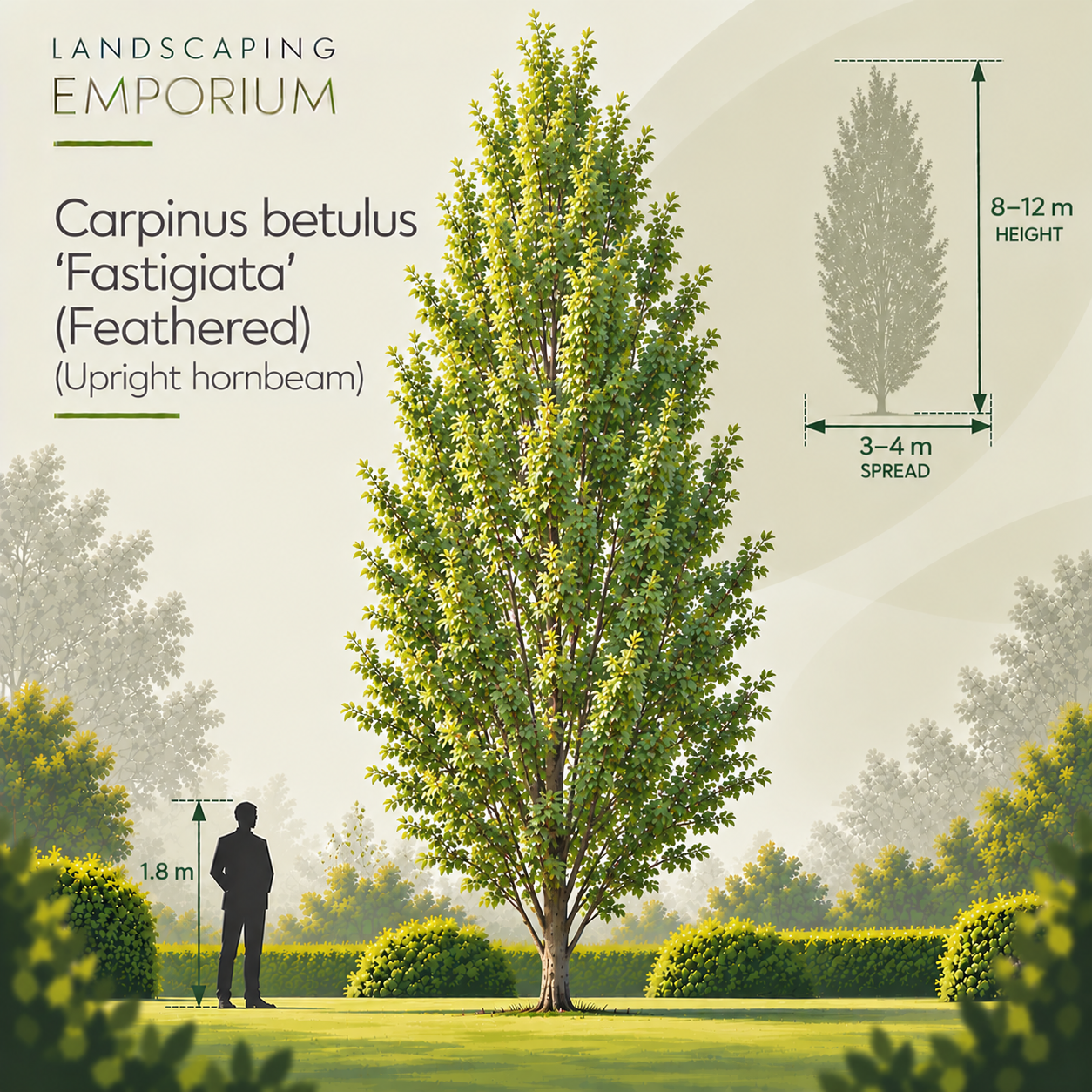
Formal | Avenue Planting
Hornbeam ‘Fastigiata’
Carpinus betulus ‘Fastigiata’
A popular upright Hornbeam with a dense,
symmetrical crown and fresh green foliage
that turns yellow in autumn.
Young trees are relatively narrow, but
the crown becomes much broader and
more rounded with age.
Ideal for formal gardens and avenues
with adequate space for its mature crown.
View Hornbeam →

Spring Blossom | Upright
Ornamental Pear ‘Chanticleer’
Pyrus calleryana ‘Chanticleer’
White spring blossom, glossy foliage
and attractive autumn colour make
this a versatile upright ornamental tree.
Its relatively narrow, pyramidal crown
is useful for entrances, avenues and
gardens where a broad-spreading tree
would be unsuitable.
View Ornamental Pear →
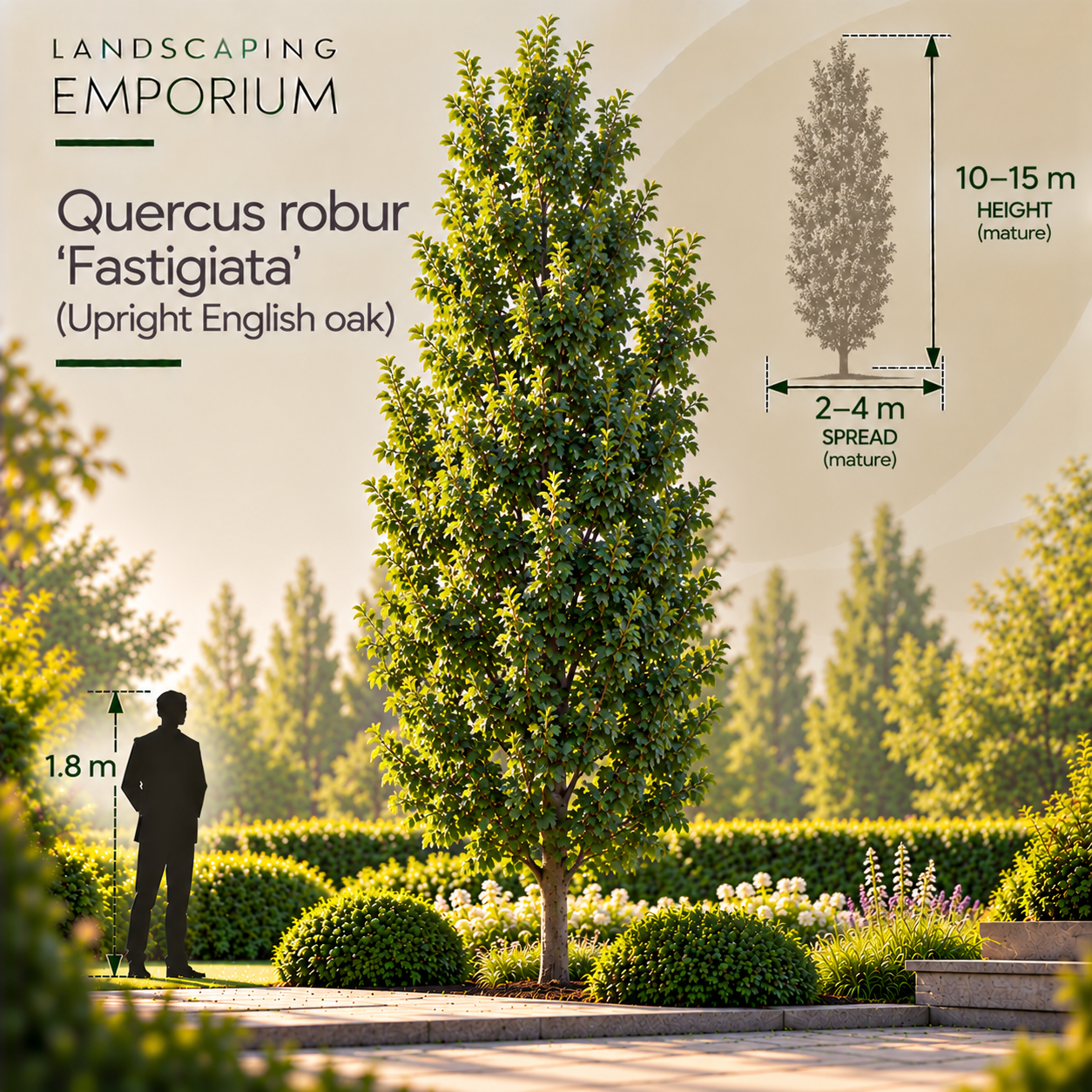
Native Species | Architectural
Fastigiate English Oak
Quercus robur ‘Fastigiata’
A distinctive upright form of English Oak
with ascending branches and a strong
vertical silhouette.
It can become a substantial tree despite
its relatively narrow crown.
Best for larger gardens, estates
and formal landscapes.
View Fastigiate Oak →
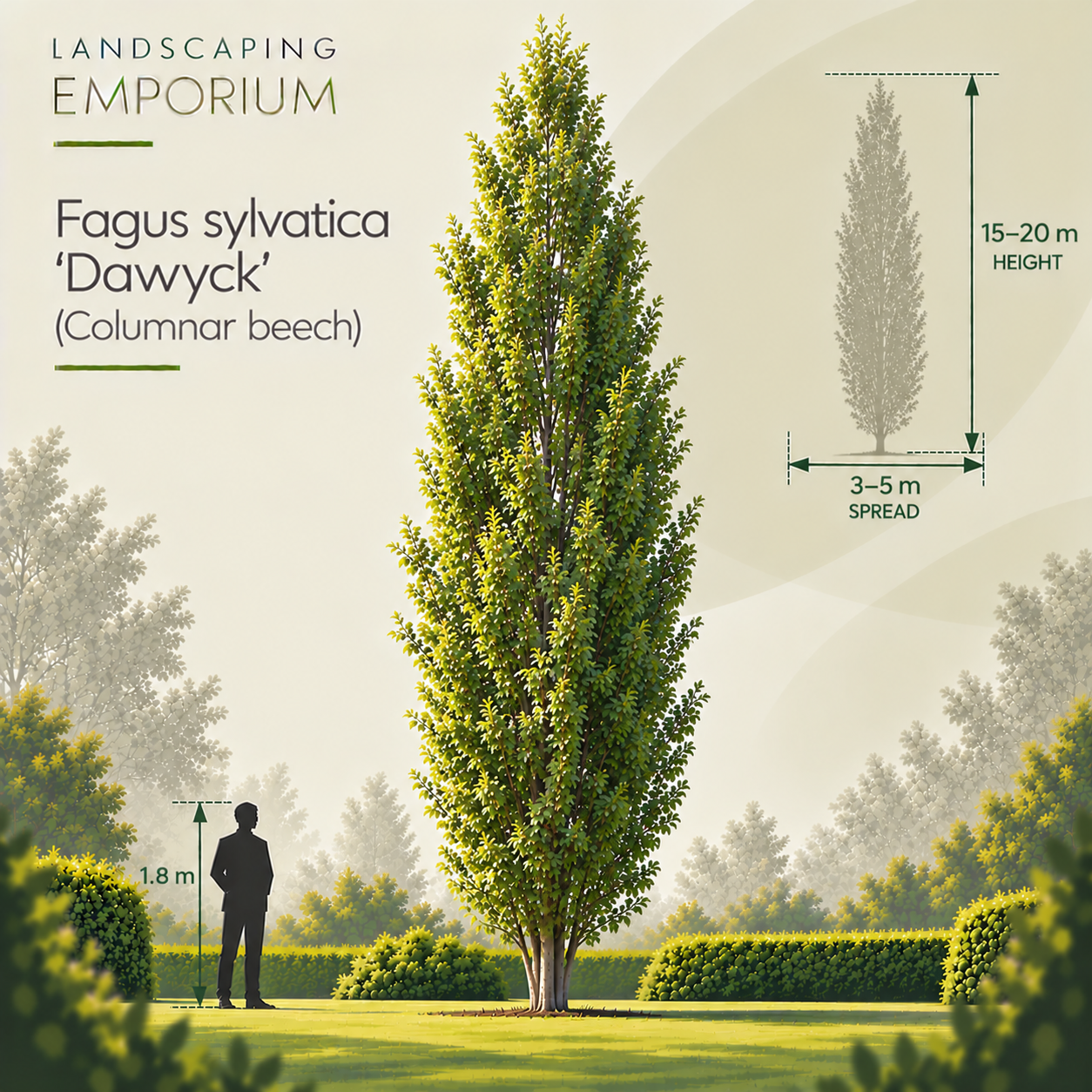
Narrow Crown | Vertical Accent
Beech ‘Dawyck’
Fagus sylvatica ‘Dawyck’
Beech ‘Dawyck’ develops a tall,
upright crown with ascending branches
and attractive green foliage.
Its strong vertical form makes it
particularly useful as a focal point
or in formal garden compositions.
It prefers suitable, well-drained soil
and requires space for its eventual height.
View Beech ‘Dawyck’ →

Evergreen | Slender
Italian Cypress
Cupressus sempervirens
Italian Cypress is renowned for its
tall, narrow evergreen silhouette,
creating a distinctive Mediterranean
architectural character.
It is particularly effective as a
vertical accent or in repeated
formal planting.
Choose a suitable narrow-growing form
and a sunny, sheltered, well-drained site.
Cold, exposed and waterlogged positions
can be problematic.
View Italian Cypress →
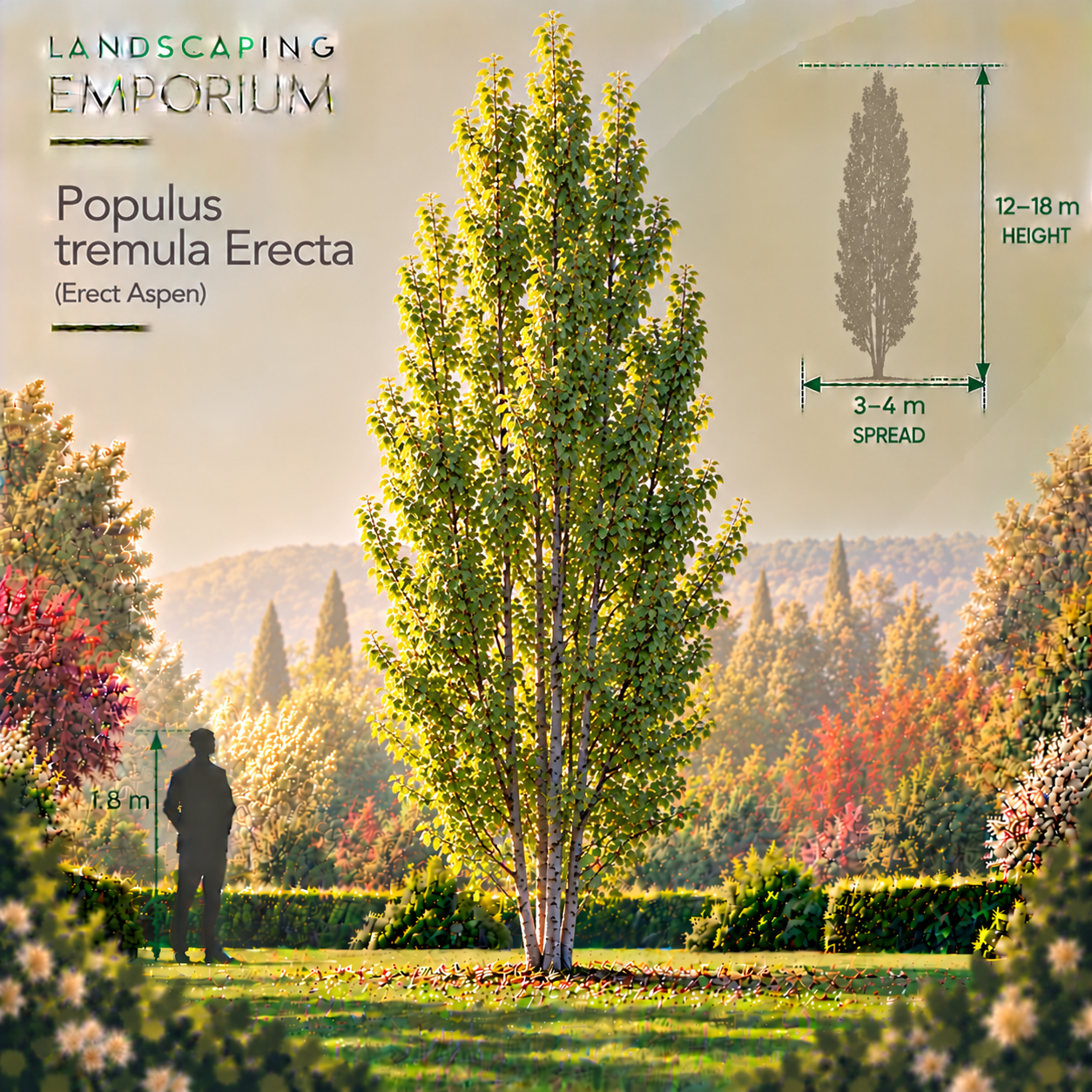
Narrow | Deciduous
Swedish Aspen ‘Erecta’
Populus tremula ‘Erecta’
Swedish Aspen ‘Erecta’ is a narrow,
upright form of Aspen with attractive
trembling leaves and a strong
vertical habit.
It is useful where a tall, slender
deciduous tree is desirable.
Consider its vigorous growth,
root behaviour and potential
for suckering before planting
near buildings or restricted spaces.
View Swedish Aspen →
Do Columnar Trees Stay Narrow?
Not necessarily. Columnar and fastigiate
describe upright growth habits, but some
trees become considerably broader with age.
Hornbeam ‘Fastigiata’, for example, often
develops a rounded, wider crown as it matures.
Other varieties, such as selected Italian
Cypress forms, can retain a much slimmer
silhouette.
Always check the mature spread,
not simply the shape of the young tree.
Compare the Best Columnar Specimen Trees
| Tree |
Foliage |
Typical Crown |
Best Use |
Important Consideration |
| Hornbeam ‘Fastigiata’ |
Deciduous |
Upright when young, broadens with age |
Avenues and formal planting |
Allow generous mature width |
| Pear ‘Chanticleer’ |
Deciduous |
Upright, pyramidal |
Entrances and ornamental planting |
Still develops a substantial crown |
| Oak ‘Fastigiata’ |
Deciduous |
Upright, relatively narrow |
Large gardens and estates |
Can become very tall |
| Beech ‘Dawyck’ |
Deciduous |
Tall and columnar |
Architectural focal point |
Needs well-drained soil |
| Italian Cypress |
Evergreen |
Very slender in selected forms |
Formal, Mediterranean-style planting |
Needs shelter and good drainage |
| Swedish Aspen ‘Erecta’ |
Deciduous |
Narrow and upright |
Vertical accent planting |
Consider roots and suckering |
Why Choose Columnar Trees?
Vertical Structure
Upright crowns create strong architectural
features and help define garden spaces.
Formal Entrances
Repeated planting can frame driveways,
entrances and pathways.
Narrow Planting Areas
Selected cultivars may suit spaces where
a broad-crowned tree would be unsuitable.
Seasonal Interest
Choose from flowering, autumn-colour
and evergreen varieties.
Columnar Trees for Small Gardens
Columnar trees can be useful where horizontal
space is restricted, but their mature height,
roots and eventual crown spread still
require careful consideration.
Ornamental Pear ‘Chanticleer’ is one option
where spring blossom and autumn colour
are desirable.
Beech ‘Dawyck’ offers a stronger vertical
silhouette, although it can become
too tall for some domestic gardens.
Explore our
Trees for Small Gardens
guide.
Best Columnar Trees for Driveways and Entrances
Upright trees can frame an entrance or
create a formal avenue without the same
immediate lateral spread as broad-crowned
species.
Hornbeam ‘Fastigiata’, Ornamental Pear
‘Chanticleer’ and fastigiate Oak are
attractive possibilities.
Plan spacing according to expected
mature crown width, not planting size.
Consider vehicle clearance, underground
services, visibility and future maintenance.
Read our
Trees for Avenue Planting
guide.
Evergreen Columnar Trees
Evergreen columnar trees provide a
vertical feature throughout the year.
Italian Cypress is an iconic example,
but it is not appropriate for every
UK garden.
In exposed, poorly drained or colder
locations, a different species or
more sheltered planting position
may be necessary.
For other year-round structural options,
see
Evergreen Specimen Trees
.
Columnar Trees for Privacy and Screening
A row of upright trees can interrupt
selected views and help define boundaries.
However, narrow crowns may leave gaps
between individual trees, particularly
during winter if they are deciduous.
Consider the height and angle of the
view you want to screen, the distance
from neighbouring properties and
the mature width of each crown.
If year-round screening is essential,
an evergreen tree or hedging solution
may be more effective.
See
Trees for Screening Neighbours
.
Columnar Trees for Clay Soil
Hornbeam and Ornamental Pear can tolerate
many heavier soils where drainage is adequate.
Beech generally prefers well-drained soil,
while Italian Cypress is poorly suited
to persistent winter waterlogging.
Because clay varies considerably between
sites, check compaction, drainage and
seasonal moisture before choosing a species.
Read our
Trees for Clay Soil
guide.
Columnar Trees for Exposed Gardens
Wind exposure affects both establishment
and long-term crown development.
Some upright deciduous trees may suit
open gardens, but narrow crowns should
not automatically be assumed wind-resistant.
Tall specimens need appropriate support
during establishment and enough rooting
volume for long-term stability.
Italian Cypress is generally better
reserved for sheltered locations.
Explore
Trees for Exposed Gardens
.
Planting and Spacing Columnar Specimen Trees
-
Check mature dimensions.
Allow for ultimate height, crown width
and root development.
-
Plan spacing.
For avenues and repeated planting,
calculate spacing using mature
crown dimensions and the intended effect.
-
Assess the site.
Check sunlight, soil, drainage,
exposure and nearby services.
-
Prepare the planting area.
Remove competing vegetation and
address compaction where necessary.
-
Plant at the correct depth.
Keep the root flare at the appropriate
finished soil level.
-
Provide suitable support.
Use staking or anchoring appropriate
to tree size and site conditions.
-
Mulch and water.
Keep mulch away from the trunk
and irrigate during establishment.
-
Monitor future clearance.
Check crown growth near buildings,
driveways and boundaries.
Professional Columnar Tree Supply and Planting
Landscaping Emporium supplies selected
upright and columnar specimen trees
for private gardens, country properties
and landscaping projects.
Through Kirman Design, professional
planting may be available across
selected areas of Lancashire,
the Ribble Valley, Greater Manchester,
Cheshire, Merseyside and Cumbria.
Our usual installation postcode areas include
BB, BL, CH1–CH5, CW8, CW9, FY, L,
LA1–LA6, M, OL, PR, SK1–SK12, WA and WN.
Availability depends on tree size,
site access, ground conditions
and project requirements.
Telephone:
01942 604976
Email:
hello@landscapingemporium.co.uk
Frequently Asked Questions
What is a columnar specimen tree?
A columnar tree has a predominantly
upright crown, often with closely
ascending branches and a relatively
narrow spread compared with its height.
What does fastigiate mean?
Fastigiate describes branches that
grow steeply upwards, creating an
upright form. Some fastigiate trees
become broader with age.
Which columnar trees are best for small gardens?
Suitable choices depend on mature size
and site conditions. Some narrow
cultivars can work well, but tall
trees may still be inappropriate
for restricted plots.
Which upright trees are best for driveways?
Ornamental Pear ‘Chanticleer’,
Hornbeam ‘Fastigiata’ and fastigiate
Oak are possibilities where mature
size, visibility and clearance
have been considered.
Are columnar trees evergreen?
Some are evergreen, such as Italian
Cypress, while Hornbeam, Beech,
Oak, Pear and Aspen are deciduous.
Which columnar trees produce flowers?
Ornamental Pear ‘Chanticleer’
produces attractive white
blossom in spring.
Do columnar trees stay narrow?
Not always. Hornbeam ‘Fastigiata’
is notably upright when young
but often develops a much
wider crown with maturity.
Can columnar trees provide privacy?
They can interrupt views, but narrow
crowns may leave gaps. Deciduous
varieties provide less screening
in winter.
How far apart should columnar trees be planted?
Spacing depends on species, mature
crown width, intended effect and
maintenance access. There is no
single spacing suitable for every
columnar tree.
Can columnar trees grow in clay soil?
Some can, including Hornbeam and
Ornamental Pear in suitable conditions.
Persistent waterlogging may make
other species unsuitable.
Are columnar trees suitable for windy sites?
Suitability varies by species and
local exposure. Tall newly planted
trees may need carefully designed
support and aftercare.
Can I buy mature columnar specimen trees?
Mature and semi-mature trees may
be available depending on nursery
stock, species, delivery access
and planting requirements.
Find the Right Columnar Specimen Tree
Whether you want a formal avenue,
a striking vertical focal point
or a tree for a narrow planting
space, the correct species and
mature dimensions are essential
to a successful design.
Browse our specimen trees or
contact Landscaping Emporium
for help with selection, available
sizes, delivery and professional planting.
