Landscaping Emporium | Specimen Trees
Best Specimen Trees for Narrow Spaces
A narrow garden does not have to mean giving up
on the beauty and structure of a specimen tree.
The right upright or columnar variety can
introduce height, seasonal colour, blossom
and year-round interest without the same
horizontal spread as a broad-canopied tree.
From elegant flowering cherries and slender
silver birches to formal beech, hornbeam
and evergreen yew, there are several
attractive options for restricted planting areas.
Discover six carefully selected specimen trees
for narrow gardens, long borders, formal
landscapes and spaces where an upright
growth habit is particularly desirable.
Six Outstanding Trees for Narrow Gardens
These six trees have been selected for their
upright growth habits, ornamental qualities
and architectural presence. Some retain
relatively narrow crowns throughout their
lives, while others become considerably
broader with maturity.
Always consider the eventual crown width,
not simply the appearance of the tree
when it is delivered.
![Betula pendula Obelisk upright silver birch tree]()
Upright Form | Birch Bark
Obelisk Silver Birch
Betula pendula subsp. pendula 'Obelisk'
An upright silver birch selected for
its vertical habit and attractive
birch character.
A useful architectural option for
narrower planting areas where the
light appearance of birch is desired.
Confirm the nursery's mature-width
specification before selecting a site.
View Obelisk Silver Birch →
Columnar Flowering Cherry
![Prunus Amanogawa columnar pink flowering cherry tree]()
Pink Blossom | Columnar
Columnar Flowering Cherry
Prunus 'Amanogawa'
An elegant upright ornamental cherry
renowned for its narrow habit and
beautiful pale-pink spring blossom.
One of the strongest choices for
narrow domestic gardens, restricted
borders and ornamental planting
where seasonal flowers are important.
View Flowering Cherry →
![Fagus sylvatica Dawyck upright columnar beech tree]()
Tall | Columnar | Architectural
Dawyck Columnar Beech
Fagus sylvatica 'Dawyck'
A striking upright beech with
a tall, columnar silhouette
and rich green summer foliage.
Excellent for formal gardens
and substantial landscapes
where vertical structure is
required without the broad
crown of a typical mature beech.
View Dawyck Beech →
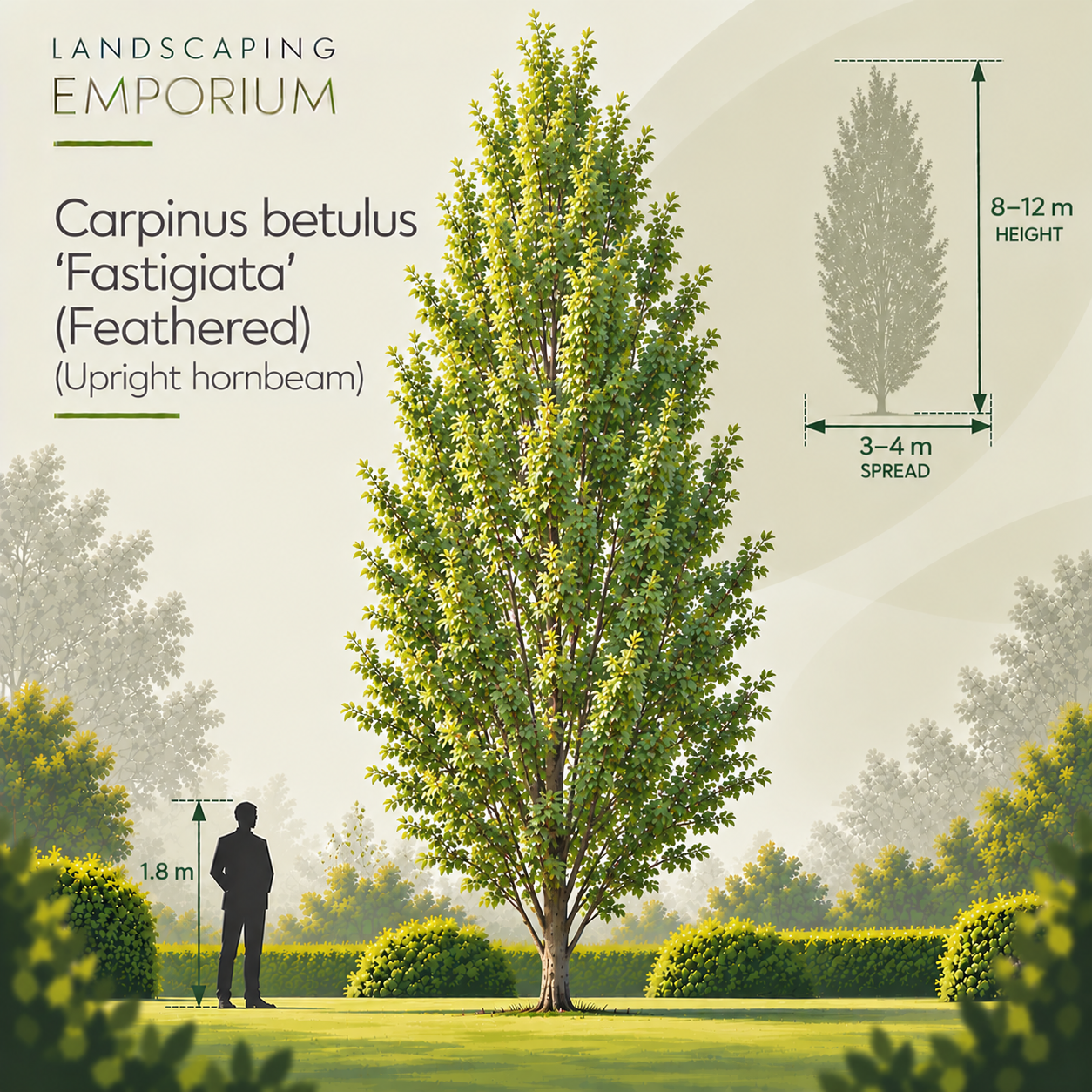
Formal Structure | Adaptable
Fastigiate Hornbeam
Carpinus betulus 'Fastigiata'
An upright hornbeam with
a strong architectural form,
attractive green foliage
and golden autumn tones.
Particularly useful for
formal planting, avenues
and structured landscapes.
Its crown becomes much
broader with age, so it
needs more space than a
genuinely columnar tree.
View Fastigiate Hornbeam →
Chanticleer Ornamental Pear
![Pyrus calleryana Chanticleer upright ornamental pear tree]()
White Blossom | Autumn Colour
Chanticleer Ornamental Pear
Pyrus calleryana 'Chanticleer'
An attractive upright ornamental
pear with abundant white spring
blossom, glossy summer leaves
and colourful autumn foliage.
An excellent option where a
relatively narrow ornamental
crown is desirable, although
the mature spread must still
be allowed for.
View Chanticleer Pear →
![Taxus baccata Fastigiata Irish Yew evergreen columnar tree]()
Evergreen | Columnar | Formal
Irish Yew
Taxus baccata 'Fastigiata'
A distinctive upright evergreen
with dense dark-green foliage
and a naturally columnar habit.
An excellent choice for
formal gardens, narrow borders
and architectural planting
where year-round structure
is important.
View Irish Yew →
What Makes a Tree Suitable for a Narrow Space?
The most important characteristic is not
necessarily the height of the tree,
but the width of its crown at maturity.
A tree may be tall and still fit
comfortably into a restricted planting
area if it has a naturally narrow habit.
However, the terms upright, fastigiate
and columnar do not guarantee that a
tree will remain narrow indefinitely.
Some varieties broaden considerably
as they mature.
Always assess the mature dimensions,
available rooting space, distance from
buildings and boundaries, and the amount
of pruning that may be required.
Compare Trees for Narrow Spaces
The following table provides a practical
comparison of the six trees. Widths are
indicative long-term ranges rather than
guaranteed dimensions. Growing conditions,
age and management can produce significant
variation.
| Tree |
Growth Habit |
Indicative Mature Spread |
Foliage |
Main Attraction |
| Obelisk Silver Birch |
Upright |
Confirm with nursery |
Deciduous |
Vertical form and birch character |
| Prunus 'Amanogawa' |
Narrow columnar |
Approximately 1–2.5m |
Deciduous |
Pink spring blossom |
| Fagus 'Dawyck' |
Tall columnar |
Approximately 3–5m |
Deciduous |
Architectural vertical structure |
| Carpinus 'Fastigiata' |
Initially upright; broadens with age |
Approximately 8–12m or more |
Deciduous |
Formal structure and autumn foliage |
| Pyrus 'Chanticleer' |
Upright pyramidal |
Approximately 3–6m |
Deciduous |
White blossom and autumn colour |
| Taxus 'Fastigiata' |
Columnar |
Approximately 2–4m |
Evergreen |
Year-round structure |
These dimensions are broad planning
guides, not planting clearances.
For exact site suitability, consult
the current nursery specification
and consider the eventual crown,
trunk and root development.
Columnar, Fastigiate and Upright Trees: What's the Difference?
Columnar Trees
Columnar trees have a relatively
narrow, vertical outline.
Prunus 'Amanogawa' and Irish Yew
are useful examples where
restricted width is a priority.
Fastigiate Trees
Fastigiate trees have branches
that grow strongly upwards.
Some maintain a narrow outline,
while others, such as Hornbeam
'Fastigiata', develop a much
broader crown with age.
Upright Pyramidal Trees
These trees have a strong
vertical form but become
wider towards the lower crown.
Pyrus 'Chanticleer' is an
example of this useful
ornamental habit.
Feathered Trees
Feathered describes a nursery
form with branches retained
along much of the main stem.
It does not describe the
tree's ultimate crown width.
Best Trees for Very Narrow Gardens
Where planting width is particularly
restricted, naturally columnar
trees are usually the most
appropriate starting point.
Prunus 'Amanogawa'
This upright flowering cherry
is particularly effective in
narrow ornamental borders
and smaller domestic gardens.
Its pale-pink spring blossom
provides a beautiful seasonal
display without requiring
the width of a conventional
spreading cherry tree.
Taxus baccata 'Fastigiata'
Irish Yew provides a contrasting
evergreen option. Its dense
foliage and upright habit make
it suitable for formal planting,
architectural accents and
year-round structure.
Neither tree should be planted
without adequate root space.
The available width must
accommodate future growth,
not just the initial rootball.
Best Trees for Long, Narrow Gardens
Long, narrow gardens can feel
like corridors if all the
planting is concentrated
along the boundaries.
Upright trees can help
introduce height and
interrupt long sightlines.
A small number of carefully
positioned columnar trees
can establish visual rhythm
without making the garden
feel crowded.
Prunus 'Amanogawa' is
particularly effective
where blossom and a softer
ornamental appearance
are desired.
For larger properties,
Dawyck Beech can introduce
strong vertical structure,
while Irish Yew can provide
a darker evergreen contrast.
Avoid planting trees at
regular intervals simply
because the garden is long.
Consider views from the
house, seating positions,
existing structures and
the intended garden layout.
Trees for Narrow Borders and Side Gardens
Restricted borders often
present additional challenges
because they are close to
fences, walls, buildings
or paved surfaces.
Before choosing a tree,
check the available soil
volume, sunlight, drainage
and access for future
maintenance.
An upright tree may have
a narrow crown but still
require a substantial
rooting area.
Prunus 'Amanogawa' and
Irish Yew are worth
considering for appropriately
sized borders.
Larger trees such as
Dawyck Beech and Fastigiate
Hornbeam generally require
more generous space.
Where the planting strip
is extremely narrow or
surrounded by hard surfaces,
a tree may not be the
most suitable solution.
Consider whether a climbing
plant, carefully maintained
hedge or alternative
screening feature would
be more appropriate.
Best Narrow Trees for Spring Blossom
Prunus 'Amanogawa'
The columnar flowering cherry
is one of the most attractive
options for spring colour.
Its upright branches carry
clusters of pale-pink blossom,
creating an elegant display
without the broad crown
of many ornamental cherries.
Pyrus calleryana 'Chanticleer'
Chanticleer Ornamental Pear
produces a generous display
of white spring blossom
followed by glossy foliage
and attractive autumn colour.
It develops a broader
pyramidal crown than
'Amanogawa', so it is
better suited to a narrow
garden with some additional
planting width.
Best Evergreen Tree for Narrow Spaces
Taxus baccata 'Fastigiata',
commonly known as Irish Yew,
is an excellent option
where year-round greenery
and vertical structure
are priorities.
Its naturally upright
habit makes it effective
as a formal accent,
entrance feature or
repeated planting
within a structured
garden design.
Irish Yew can be maintained
through careful pruning,
although sufficient space
must still be allowed
for its mature growth.
Important:
Yew is poisonous if
ingested and may not
be appropriate where
children, pets or
grazing animals could
consume the foliage
or seeds.
Upright Trees for Larger Gardens
Not every upright tree
is suitable for a small
or extremely narrow garden.
Some develop considerable
height and eventually
become relatively broad.
Fagus sylvatica 'Dawyck'
Dawyck Beech is a striking
architectural tree that
provides substantial
vertical emphasis.
It is best suited to
larger gardens and
landscapes with sufficient
space for its eventual
height and crown.
Carpinus betulus 'Fastigiata'
Fastigiate Hornbeam has
an attractive upright
form when young but
develops a much broader,
rounded crown with age.
It is particularly useful
for formal landscapes,
avenues and substantial
garden designs, rather
than genuinely restricted
domestic planting strips.
For more substantial
planting schemes, explore
our
Trees for Large Gardens
guide.
Can Narrow Trees Provide Privacy?
Upright trees can provide
useful visual screening,
particularly where the
view to be obscured is
at a higher level.
However, a narrow specimen
tree does not necessarily
provide continuous privacy
along a boundary.
Several trees may be needed,
and the spacing between them
must allow for future
growth and maintenance.
Evergreen Irish Yew
can provide more consistent
winter foliage, while
deciduous trees may
offer screening mainly
during the growing season.
If privacy is your main
objective, read our
Trees for Screening Neighbours
guide before deciding
on a species.
How Close Can You Plant a Tree to a Fence or House?
There is no universal
minimum planting distance
that applies to every
tree or property.
The correct position
depends on the species,
mature crown spread,
root development,
soil conditions,
nearby foundations
and underground services.
A narrow crown does not
mean the root system
will remain confined
to the same width.
Where trees are being
planted close to buildings,
retaining walls or
other structures,
professional advice
should be obtained
before planting.
Choosing the Right Tree for Your Soil
A tree's growth habit
is only one part of
successful selection.
The soil must also
be suitable for the
chosen species.
Consider the following:
-
Clay soil:
Assess drainage and compaction,
particularly during winter.
Hornbeam can be useful
on heavier soils.
-
Free-draining soil:
Check moisture availability,
especially during the
establishment period.
-
Waterlogged ground:
Persistent saturation
can damage the roots
of many ornamental trees.
-
Shaded gardens:
Select a species suited
to the available light,
rather than relying
on crown shape alone.
-
Exposed positions:
Consider wind tolerance
and the support required
during establishment.
If you are uncertain
about the conditions
in your garden, our
Specimen Tree Selector
can help narrow
down the options.
Planting and Establishing Upright Specimen Trees
-
Measure the space.
Record the available
planting width, distance
to boundaries and
overhead restrictions.
-
Check mature dimensions.
Use the nursery's
ultimate height and
spread information.
-
Assess the soil.
Check drainage, compaction,
soil type and access
to moisture.
-
Plan delivery access.
Larger rootballed
specimens may require
mechanical handling.
-
Plant at the correct depth.
Avoid burying the
root flare beneath
the finished soil level.
-
Support appropriately.
Use suitable staking
or anchoring where
required.
-
Water consistently.
Newly planted trees
require careful
watering during
establishment.
-
Maintain a mulch area.
Keep grass and weeds
away from the roots,
but avoid piling mulch
against the trunk.
-
Inspect regularly.
Check supports,
soil moisture and
tree condition
during the first
growing seasons.
For further advice,
read our
Tree and Hedging Aftercare Guide
.
Specimen Tree Supply and Planting in North West England
Landscaping Emporium supplies
selected specimen trees for
gardens, residential properties
and landscape projects.
Through Kirman Design,
professional planting may
also be available in
selected areas of
Lancashire, the Ribble Valley,
Greater Manchester,
Cheshire, Merseyside
and Cumbria.
We can help you consider
tree selection, available
nursery sizes, delivery
access and the practical
requirements of planting
in a restricted space.
Browse our
Specimen Tree Collection
or use the
Find the Right Specimen Tree
selector.
Frequently Asked Questions
What is the best tree for a very narrow garden?
Prunus 'Amanogawa' is one
of the strongest ornamental
choices because of its
naturally narrow habit
and spring blossom.
Irish Yew is a useful
evergreen alternative.
The final choice depends
on available width,
soil and light.
Which trees stay narrow as they grow?
Naturally columnar trees
generally retain a narrower
outline than broad-canopied
species. Prunus 'Amanogawa'
and Taxus baccata 'Fastigiata'
are useful examples, although
both still require room
for mature growth.
What is the difference between a columnar and fastigiate tree?
Columnar describes a
narrow vertical crown,
while fastigiate describes
strongly ascending branches.
Some fastigiate trees
become substantially
broader with maturity.
Which narrow tree has pink blossom?
Prunus 'Amanogawa'
produces attractive
pale-pink spring blossom
and is a popular choice
for restricted ornamental
planting spaces.
Which upright tree has white blossom?
Pyrus calleryana 'Chanticleer'
produces white spring blossom
and has a relatively upright,
pyramidal habit.
What is the best evergreen tree for narrow spaces?
Taxus baccata 'Fastigiata',
or Irish Yew, is an
excellent option for
formal evergreen structure.
It should be positioned
where its mature dimensions
can be accommodated.
Is Fastigiate Hornbeam suitable for a very narrow garden?
Not usually in the long term.
Although it has an upright
habit when young, it
develops a much broader
crown as it matures.
It is better suited
to more generous spaces.
Can I plant an upright tree close to my house?
The correct planting
distance depends on
the tree species,
soil, foundations
and available space.
A narrow crown does
not necessarily mean
a small root system.
Seek professional advice
where trees are to be
planted near buildings.
Can upright trees be used for screening?
Yes. Upright trees
can help screen views
and introduce vertical
privacy, although
deciduous species lose
their foliage in winter.
The spacing and eventual
crown width must be
considered carefully.
Can Landscaping Emporium plant the trees for me?
Professional specimen
tree planting may be
arranged through
Kirman Design in
selected areas of
North West England,
subject to site access
and project requirements.
Find the Right Tree for Your Narrow Garden
Whether you need a slender
flowering tree, a columnar
evergreen or an upright
architectural specimen,
choosing the correct
mature size is essential.
Explore our tree collection,
compare the six varieties
above or contact our
team for guidance on
planting in restricted spaces.
